Worn Through Decades: The True Economics of a Shoe Built to Endure
Photo: Joe Haupt from USA, CC BY-SA 2.0, via Wikimedia Commons
There is a particular kind of pride that arrives quietly, without announcement. It is the pride of pulling on a pair of shoes that have outlasted a mortgage payment, a change of government, perhaps even a marriage or two — and finding them, if anything, more handsome for the wear. In Britain, this relationship with enduring objects runs deep. We are, at our best, a nation that values what lasts.
Yet for many younger buyers approaching quality footwear for the first time, the upfront cost of a genuinely well-made shoe presents an obstacle that feels almost philosophical. Why spend three hundred pounds on a single pair when a high-street alternative can be had for thirty? The answer, it turns out, is not a matter of taste alone. It is a matter of arithmetic.
The Mathematics of the Long Wear
Cost-per-wear is a concept that has gained considerable traction among those who study the economics of personal dress, and it applies nowhere more clearly than in footwear. Consider a shoe purchased for £320 that, with appropriate care, remains in active rotation for twenty years. Worn conservatively twice a week, that shoe accumulates over two thousand wearings across its lifetime. The cost per occasion drops to roughly fifteen pence — considerably less than a cup of coffee, and a good deal more satisfying.
Contrast this with a £40 shoe that begins to delaminate after eighteen months and must be replaced annually. Over the same twenty-year span, the buyer will have spent £800 and received, in return, a succession of objects that offered no particular pleasure and left no particular impression. The 'affordable' shoe, examined honestly, is the expensive one.
This logic is not merely theoretical. It is the lived experience of a significant number of British shoe wearers who made a single considered purchase in their twenties or thirties and have not revisited the decision since.
Voices from the Long Game
David, a retired solicitor from Edinburgh, purchased his first pair of quality Oxfords in 1987. He wore them to his call to the bar, to his daughter's graduation, and — with some ceremony — to his own retirement dinner last spring. 'They've been resoled twice,' he says, 'and reconditioned more times than I can count. But the upper leather is the same leather I bought. That continuity means something to me.'
In Cheshire, a retired headmistress named Margaret describes a pair of court shoes she acquired in the early 1990s as 'the most reliable things I own, including my car.' She had them reheeled four times and the insoles replaced once. They remain, she insists, her preferred choice for occasions that demand composure.
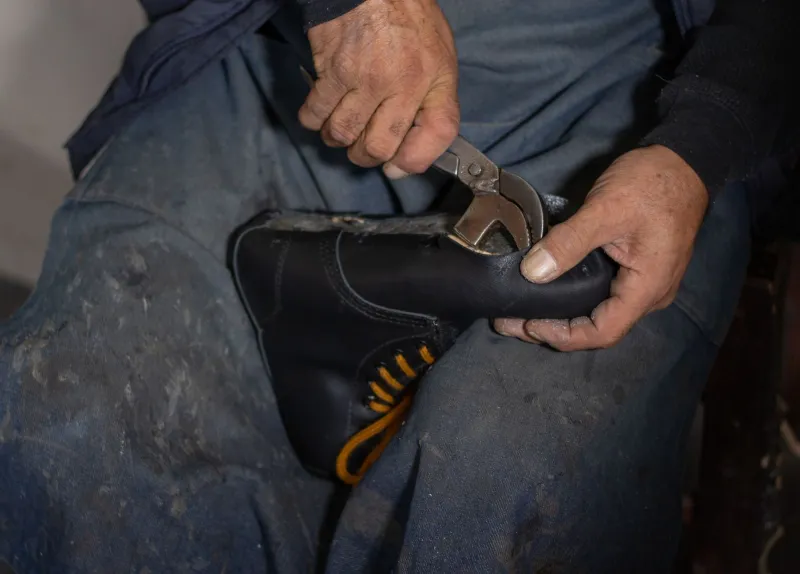
These are not isolated anecdotes. They represent a pattern that any cobbler of sufficient experience will recognise immediately: the shoes that return for repair, decade after decade, are almost invariably those made to a standard that rewards the investment of maintenance. The others, he will tell you, simply do not come back.
What Makes a Shoe Worth Keeping
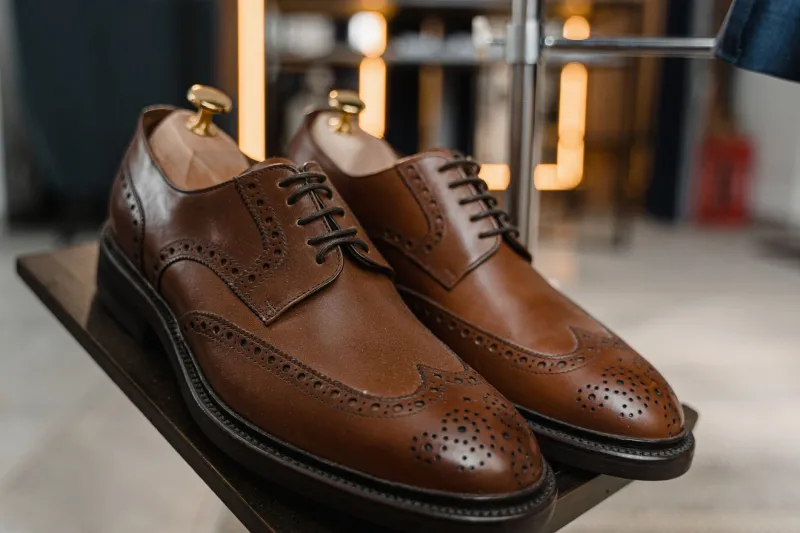
The qualities that confer longevity upon a shoe are not mysterious, though they are frequently misunderstood. Construction method matters enormously. The Goodyear welt — a technique that stitches the upper, insole, and outsole through an intermediate strip of leather — allows for repeated resoling without compromising the structural integrity of the shoe. A cemented or glued construction, however convincing it may appear in the shop, offers no such possibility. When the sole fails, the shoe is finished.
Leather quality is equally decisive. Full-grain leather, taken from the outermost layer of the hide, retains the natural fibres that give it both strength and the capacity to develop a patina over time. It breathes, it moulds gently to the foot, and it responds to polish and conditioning in a way that synthetic materials simply cannot replicate. A shoe made from full-grain leather does not merely age — it improves.
Last shape, too, plays a role that extends beyond aesthetics. A last designed with structural integrity distributes weight evenly, reducing the stress on any single point of the upper and extending the working life of the shoe considerably.
The Inheritance That Needs No Solicitor
Beyond economics, there is something else at work in the British attachment to enduring footwear — something that resists quantification but is no less real for that. A shoe worn across the span of a life becomes, in a quiet way, a record of that life. The slight softening of the leather at the toe, the particular polish built up through years of Sunday mornings, the repair carried out by a cobbler who remembered your grandfather — these are not flaws. They are biography.
It is not uncommon for quality shoes to pass between generations. A son inherits his father's brogues and finds, after the briefest period of adjustment, that they fit well enough to continue the story. The leather, properly maintained, has no objection to a new chapter.
This is the inheritance that requires no solicitor and no probate — only the will to look after what one has been given.
A Considered Approach for the Sceptical Buyer
For those approaching quality footwear for the first time, the practical advice is straightforward: buy less, buy better, and treat what you buy with the seriousness it deserves. A single pair of well-made shoes, rotated properly and maintained with appropriate products, will outlast four pairs of inferior alternatives purchased in the same period.
Begin with one pair that addresses your most frequent occasion — whether that is professional, social, or both. Invest in cedar shoe trees, which absorb moisture and preserve the shape of the last. Learn the modest art of polishing leather, which takes perhaps ten minutes and returns results entirely disproportionate to the effort. And find a cobbler you trust before you need one urgently.
The shoe built to last does not ask much in return. It asks only that you recognise, at the moment of purchase, that you are not buying a commodity. You are beginning a relationship — one that, with a little care, may well outlast most of the other commitments you make this year.