A Leather Legacy: Deciding the Fate of Your Father's Brogues
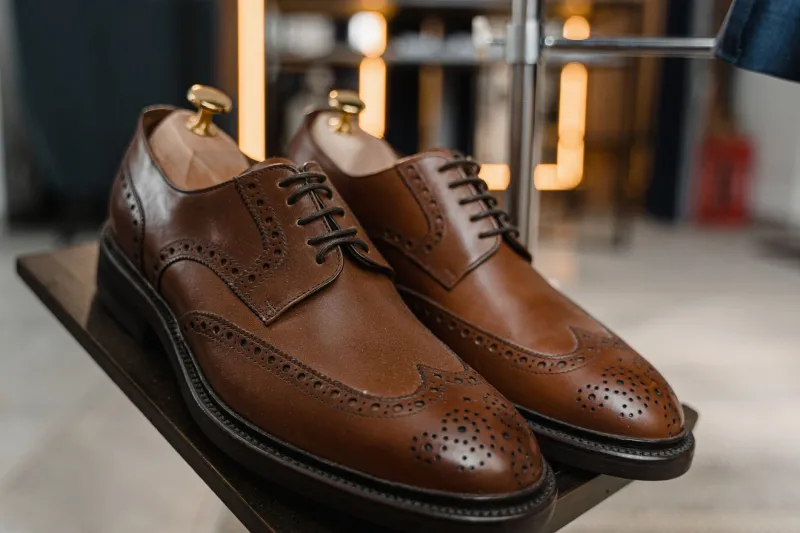
There is a particular kind of silence that descends when you open a shoebox belonging to someone who is no longer here. The smell of aged leather and cedar, the faint impression of a heel worn down at a familiar angle — these are not merely shoes. They are a record of a life conducted with a certain seriousness of purpose. And yet, sentiment alone cannot determine whether a pair of Oxfords ought to migrate from the wardrobe of one generation into another.
The question of inherited footwear is one that British families have quietly grappled with for generations. Unlike a watch or a signet ring, shoes carry the literal shape of another person's body. That intimacy is both their power and their complication.
Reading the Shoe Before Making Any Decision
Before sentiment or practicality can hold sway, the shoes themselves must be assessed honestly. A well-made British shoe — constructed using traditional Goodyear welt methods, with a full leather sole and quality upper — is built to outlast its original owner by decades, provided it has been maintained with reasonable care. The first question, therefore, is not whether you want to wear them, but whether they are structurally sound enough to reward the effort of restoration.
Examine the welt — the strip of leather stitched between the upper and the sole — for cracking or separation. Inspect the heel counter, the stiffened section at the back of the shoe, to determine whether it retains its shape. Run your hand along the interior and feel for the integrity of the insole. If the leather upper has dried but not cracked, if the sole has worn evenly rather than catastrophically, and if the last — the mould around which the shoe was built — still holds its form, you are likely looking at a candidate for revival.
Shoes that have been stored correctly, wrapped in tissue and kept away from damp, may require little more than a thorough clean, a conditioning treatment, and resoling. Those that have been neglected, however, may present challenges that even a skilled cobbler cannot fully reverse.
The Sizing Question: Honest Answers Required
This is where many sentimental journeys reach an abrupt terminus. A shoe that does not fit cannot be willed into service through affection. Unlike a jacket, which may be taken in or let out, the last of a shoe is fixed. Half a size in either direction may be navigable with the right insole or sock combination, but anything beyond that is a concession to vanity rather than practicality.
It is worth having your feet properly measured before dismissing a pair outright. Foot size does shift across adulthood, and a shoe you might have dismissed at thirty could, by forty-five, correspond rather more closely to your own dimensions. British shoe sizing, moreover, has historically varied between makers, and a size nine from a Northampton manufacturer of the 1970s may sit differently on the foot than a contemporary equivalent.
If the fit genuinely cannot be reconciled, this is not a failure of devotion. It is simply a fact of anatomy, and one that the original wearer would likely have understood entirely.
When Restoration Is the Right Answer
Should the shoes pass both the structural and sizing assessments, the case for restoration becomes compelling. A reputable cobbler — and Britain retains a number of exceptional craftsmen, particularly in London and the Midlands — can resole, re-heel, recondition, and in some cases re-welt a shoe that appears, to the untrained eye, beyond saving.
The transformation that skilled hands can achieve on a pair of neglected Northampton brogues is, frankly, remarkable. Leather that appeared desiccated and dull can recover much of its original lustre with proper treatment. A new sole, fitted by someone who understands the geometry of the original construction, can extend a shoe's life by another decade or more.
Restoration also carries its own form of meaning. To wear a shoe that has been deliberately brought back from the brink is to participate in a lineage of care — to extend, rather than merely inherit, a tradition of quality. There is nothing sentimental about this in a mawkish sense. It is, rather, a quietly practical form of respect.
When Memory Serves Better Than the Wardrobe
Not every inherited shoe belongs on a living foot. Some pairs are too worn to be restored without losing the character that makes them significant. Others may be of a style so firmly rooted in their era that wearing them would feel performative rather than genuine. And some — particularly those of great age or unusual provenance — may carry a historical interest that transcends their utility.
In such cases, preservation rather than wear is the more fitting tribute. A shoebox lined with acid-free tissue, stored somewhere stable, keeps the object intact without demanding that it perform a function it can no longer fulfil. Photographs, too, offer a way of recording the shoes' story without subjecting them to further wear.
There is no shame in acknowledging that a pair of shoes has completed its active life. The acknowledgement itself is a form of respect — a recognition that the object has already done its work and need not be pressed into further service.
The Etiquette Nobody Discusses
There is an unspoken question beneath all of this: what does it mean to wear someone else's shoes? In British culture, where emotional expression tends toward the oblique, the act of slipping on a deceased father's Oxfords carries a weight that is rarely articulated directly.
Some find it grounding — a physical connection to a person they miss. Others find it uncomfortable, as though occupying a space that still belongs to someone else. Neither response is incorrect. What matters is that the decision is made consciously, rather than by default or out of guilt.
A shoe chosen with intention — whether to wear, restore, preserve, or pass along — honours its history more fully than one that simply sits in a wardrobe, neither used nor released. The finest British shoes were made to be decided about. That, in itself, is part of their inheritance.