Stitched in Time: The Lost Arts of British Shoemaking and Their Quiet Return
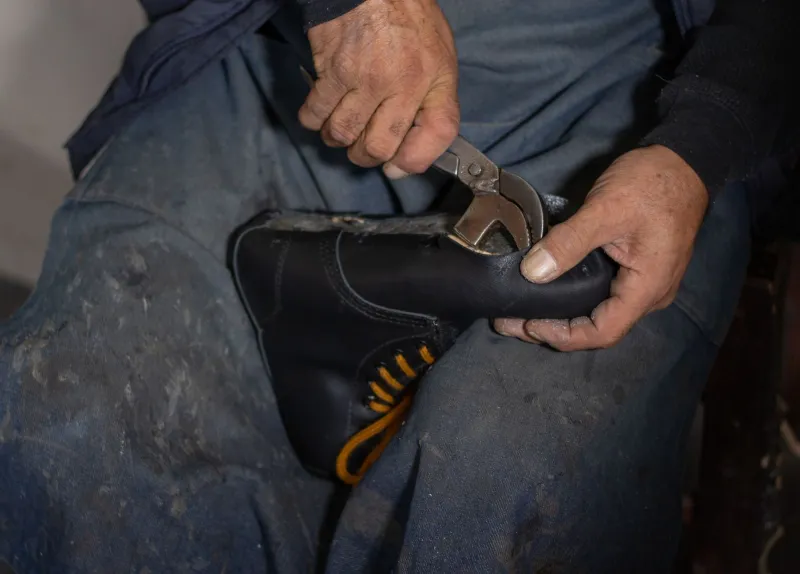
There is a particular sound a well-made shoe makes when it meets a stone floor — a clean, grounded report that speaks not merely of weight, but of density, of substance, of intention. It is a sound increasingly difficult to produce with the materials and methods favoured by volume manufacturers. Yet in workshops across Britain, from the terraced streets of Northampton to modest premises in Somerset and Shropshire, that sound is being coaxed back into existence by craftspeople who have chosen craft over convenience.
These makers are not simply nostalgists. They are practitioners of a rigorous discipline, one that demands years of apprenticeship, an intimate understanding of natural materials, and a willingness to work at a pace entirely incompatible with modern retail cycles. What they produce, however, is footwear that endures — in construction, in character, and in the quiet authority it lends to every step.
The Welt That Changed Everything — and Was Then Forgotten
The Goodyear welt, named after the American inventor Charles Goodyear Jr. but embraced most enthusiastically by British shoemakers in the nineteenth century, revolutionised the industry. A strip of leather stitched simultaneously to the upper and the insole, it created a shoe that could be resoled multiple times without compromising structural integrity. For much of the twentieth century, it remained the benchmark of quality construction.
Then came the cemented sole — glued rather than stitched, faster to produce, cheaper to manufacture. By the 1980s, even shoes marketed at premium price points had begun to quietly abandon the welt. The consumer rarely noticed, at least not immediately. The difference becomes apparent only after several years of wear, when a cemented sole begins to separate and the shoe is declared finished, whilst a welted equivalent might simply require a visit to a competent cobbler.
Master cordwainer Thomas Ashford, who has operated a small workshop in Kettering for over three decades, describes the shift with measured frustration. "The welt was never abandoned because it stopped working," he explains. "It was abandoned because it required skill and time, and skill and time cost money. The moment a customer stopped being able to tell the difference at the point of purchase, the incentive to maintain the standard largely disappeared."
Ashford and craftspeople of his generation — alongside younger makers who have sought out their mentorship — are restoring the Goodyear welt to its proper prominence. More significantly, some are going further still, reviving the hand-welting tradition that predates even the mechanised version: a technique requiring the sole channel to be cut and folded by hand, stitched with a curved needle, and burnished closed. The result is a construction of almost architectural solidity.
Natural Leather Treatments: When Patience Was the Process
The transformation of raw hide into workable leather is, at its finest, a process measured in months rather than hours. Traditional oak-bark tanning — in which hides are submerged in progressively stronger solutions of tannin derived from oak bark, moving through a series of pits over a period of up to fourteen months — produces a leather of exceptional density, water resistance, and character. It is a process with a traceable lineage stretching back to Roman Britain.
By contrast, the chrome-tanning method introduced in the late nineteenth century can produce finished leather in as little as a day. It is not without its merits — chrome-tanned leather is supple and consistent — but it lacks the depth and longevity of its oak-bark counterpart. The sole leather produced through traditional pit-tanning, in particular, offers a durability that synthetic alternatives and hastily processed hides cannot approach.
J. & F.J. Baker & Co. in Devon, one of only a handful of remaining oak-bark tanneries in the world, supplies leather to a small but devoted community of British shoemakers who regard provenance as inseparable from quality. "When you work with pit-tanned leather," notes one Northamptonshire maker who sources exclusively from traditional tanneries, "you are working with something that has already been patient. It asks patience of you in return. You cannot rush it, and you would not wish to."
The finishing of uppers, too, has its own lost lexicon. Hand-boarding — a process in which the leather is repeatedly folded and worked by hand to achieve a particular grain pattern and suppleness — was once standard practice in quality workshops. So too was the application of tallow and natural waxes to condition leather during construction, rather than merely at the point of retail presentation. These practices are being reclaimed, quietly but with conviction.
The Apprenticeship Question
Perhaps the most significant threat to the survival of these techniques is not commercial indifference but demographic reality. The knowledge required to hand-last a shoe, to cut a pattern with the precision that accounts for a specific customer's gait, to finish an edge with the graduated layers of wax and burnishing that give a fine shoe its distinctive lustre — this knowledge lives in hands and eyes and muscle memory. It cannot be adequately transmitted by manual or video tutorial alone.
The Cordwainers' tradition of formal apprenticeship, in which a young craftsperson would spend years working beside a master before attempting independent commissions, has contracted severely over the past half-century. Several dedicated training programmes — including those associated with De Montfort University in Leicester and various industry bodies — have worked to address this, with some success. But the pipeline remains narrow.
"Every time a master retires without passing on what they know, something is permanently lost," observes one industry figure with long experience of the British footwear trade. "Not a technique that can be looked up, but the particular understanding of how that technique behaves under specific conditions, with specific materials. That is irreplaceable."
It is precisely this irreplaceability that lends hand-crafted British footwear its genuine value — a value that extends well beyond the aesthetic. A shoe made by someone who has spent a career mastering their discipline carries within it an accumulation of knowledge that no algorithm can replicate.
What the Discerning Customer Gains
For those who choose footwear with genuine attention — who regard their shoes as long-term companions rather than seasonal accessories — the revival of traditional British craft offers something of considerable practical worth. A shoe constructed with a hand-stitched welt, soled in pit-tanned leather, and finished with natural waxes will, with appropriate care, outlast many cheaper alternatives many times over. The economics, viewed across a decade rather than a single season, are compelling.
Beyond longevity, there is the question of character. A shoe that has been shaped by hand, that bears the subtle irregularities of individual attention, develops a patina over time that factory production cannot simulate. It becomes, in the truest sense, particular — shaped by its maker, then further shaped by its wearer.
This is the promise of British craft at its finest: not merely a well-made object, but an object with a continuing story. In returning to the techniques that nearly disappeared, a new generation of British shoemakers is ensuring that story has chapters worth reading.