Structure in Every Step: How Britain's Architectural Legacy Shapes the Luxury Shoe Silhouette
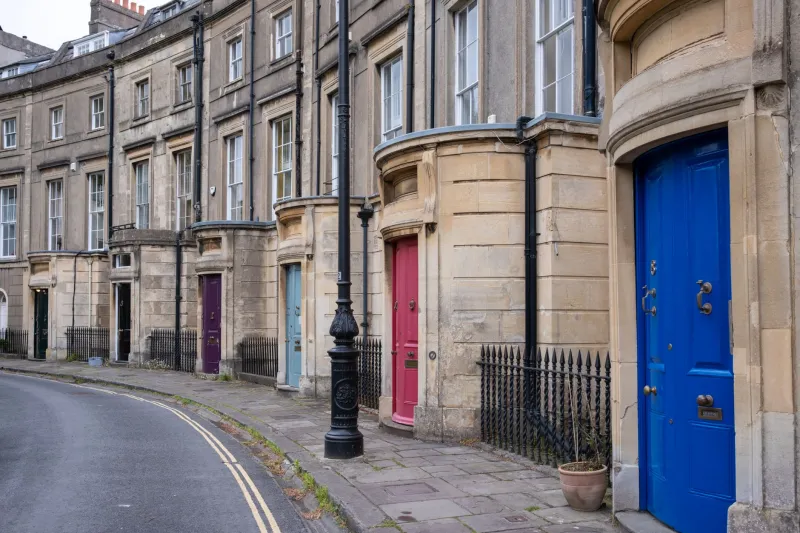
Stand at the top of Regent Street on a quiet morning and look south. The sweeping Regency façades, designed by John Nash in the early nineteenth century, present a lesson in controlled elegance: every column proportioned to its neighbour, every cornice placed with mathematical deliberation, the whole composition conveying grandeur without ostentation. It is, by any measure, a masterclass in the art of restraint.
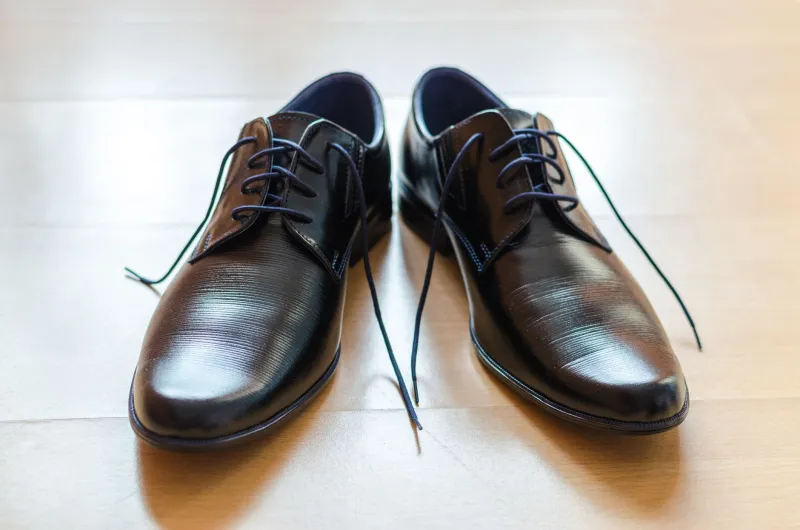
Now consider the Oxford brogue — that most quintessentially British of shoes. Its closed lacing system, its disciplined perforations tracing the seam lines with decorative precision, its toe cap measured and placed with an almost architectural exactitude. The parallel is not accidental. Britain is a nation whose aesthetic sensibility has been formed, for centuries, by the buildings it inhabits — and that sensibility flows, often unconsciously, into the objects its craftspeople make.
Georgian Proportions: The Foundation of the British Shoe
The Georgian period, spanning roughly 1714 to 1830, produced an architectural language so deeply embedded in British culture that its principles continue to inform design across almost every discipline. The Palladian ideal — symmetry, proportion, the subordination of ornament to structure — found its fullest British expression in the terraces of Bath, the squares of Edinburgh's New Town, and the townhouses of Bloomsbury.
For shoemakers of the same era and those who followed in their tradition, these principles translated into a philosophy of form: that a shoe, like a well-designed building, should derive its beauty from the integrity of its construction rather than the extravagance of its decoration. The last — the wooden form around which a shoe is built — performs precisely the same function as the architect's proportional grid. It determines everything: the pitch of the heel, the sweep of the waist, the relationship between toe and counter.
Contemporary British designers working in the luxury segment frequently invoke this heritage. "When I'm working on a new silhouette," notes one London-based shoemaker with two decades of experience on Jermyn Street, "I'm thinking about balance in the same way an architect thinks about a façade. Where does the weight sit? Where does the eye travel? Is the whole resolved?"
Victorian Craft and the Celebration of Detail
If the Georgian period gave British shoemaking its structural vocabulary, the Victorian era gave it its enthusiasm for craft as a form of expression. The great Gothic Revival architects — Pugin, Scott, Butterfield — argued passionately that every surface, however minor, deserved the attention of a skilled hand. Ornament was not superfluous; it was, properly understood, a moral statement about the value of human labour.
This ethos found a natural home in the shoemaking workshops of Northampton, which by the mid-nineteenth century had established themselves as the global centre of quality footwear production. The broguing patterns that distinguish the classic Derby and Oxford — those intricate rows of punched decoration following the seam lines with almost ecclesiastical precision — owe something of their character to this broader Victorian conviction that the decorative and the structural need not be in conflict.
The medallion on the toe cap of a fine brogue, for instance, is not merely ornamental. It draws the eye to the apex of the shoe, anchoring the design in the same way that a keystone anchors an arch. Its removal would leave the composition feeling incomplete — an observation that any architect working in the Gothic tradition would have found immediately intelligible.
Brutalism and the Bold Silhouette
The mid-twentieth century brought a more confrontational aesthetic to British architecture. The Brutalist movement — expressed in buildings such as the Barbican in the City of London, the National Theatre on the South Bank, and the Trellick Tower in North Kensington — embraced raw materiality, geometric assertiveness, and a refusal to conceal structure behind decorative cladding. Concrete was left exposed. Forms were angular, unapologetic, and deliberately monumental.
It would be too simple to draw a direct line from these buildings to any single shoe design. But the Brutalist period did contribute something important to the British design consciousness: a willingness to let material speak for itself, and a comfort with forms that challenge rather than merely please.
This influence can be traced, with some care, in the more architecturally ambitious footwear silhouettes that have emerged from British designers in recent decades — chunky platform soles that reference the podium levels of Barbican courtyards, angular heel constructions that recall the chamfered edges of exposed concrete, and uppers in unadorned leathers that celebrate the material's natural grain rather than concealing it beneath polish and pigment.
"There's a generation of British designers who grew up walking past these buildings," observes a footwear design lecturer at a leading London art college. "The Brutalist aesthetic has become part of the visual language they draw on without necessarily being conscious of it. You see it in the boldness of the forms, in the confidence with which structural elements are left visible rather than hidden."
Modernism and the Pared-Back Aesthetic
Between the Victorian celebration of ornament and the Brutalist assertion of structure sits the quieter influence of British Modernism — the clean lines of the Festival of Britain, the rational elegance of post-war civic architecture, the understated geometry of the Arts and Crafts movement as it evolved through the twentieth century.
In footwear, this tradition manifests as a commitment to the well-resolved silhouette: the shoe that achieves its effect through the perfection of its line rather than the complexity of its decoration. A plain-toe Oxford in a single colour, its only seam the cap line, is as much a Modernist object as a Denys Lasdun building. Its beauty is inseparable from its economy.
This is, perhaps, the most enduring architectural lesson that British shoemaking has absorbed: that the finest design is not the most elaborate, but the most considered. That every element must earn its place. That the whole, when properly resolved, should feel inevitable — as though no other form were possible.
A Living Dialogue
The relationship between British architecture and British shoemaking is not a matter of direct quotation or conscious homage. It is something more diffuse and more interesting: a shared sensibility, shaped by the same cultural landscape, expressing itself through different materials and different scales.
The craftsman in a Northampton workshop and the architect at a drawing board in Clerkenwell are, in a meaningful sense, engaged in the same project — the project of giving form to space, of resolving the tension between structure and surface, of making something that will endure. That the results of one can be worn on the foot and the results of the other can be inhabited makes them different in degree, not in kind.
For those who wear fine shoes with the attention they deserve, this is worth considering. The shoe on the foot is not merely a functional object. It is, in the oldest and most serious sense of the word, a piece of design — and design, in Britain, has always been shaped by the stones and steel and Portland limestone of the buildings that surround us.