What a Scuff Reveals: The Quiet Discipline of British Shoe Care
In certain circles, a man's shoes are read before his words are heard. The British tradition of shoe care is not merely a matter of aesthetics — it is a discipline that speaks to character, stewardship, and a deeply held belief that what one owns, one is obliged to honour. To understand how a gentleman tends his footwear is, in many respects, to understand how he tends everything else of value in his life.
There is an entire grammar to this practice — unwritten, seldom discussed openly, yet broadly understood by those who have been raised within its traditions. A scuff left unattended is not simply a blemish. It is a sentence left incomplete.
The Vocabulary of Neglect
Begin with what absence communicates. A shoe that has been worn regularly but never treated with cream carries the dull, desiccated surface of leather that has been asked to give without ever being replenished. The colour fades at the toe cap first, then across the vamp, eventually retreating into a kind of grey indifference. It is not the wear itself that signals carelessness — leather was always meant to be worn — but the failure to respond to that wear with any corresponding act of restoration.
The British gentleman's relationship with his shoes has historically been one of active participation. He does not simply wear them; he reads them. After a long day, he notices where the leather has creased, where moisture has begun to mottle the surface, where the heel has compressed slightly beneath the insole. These observations are not vanity. They are the preliminary notes of a craftsman assessing the work ahead.
This attentiveness extends to the tools selected. A gentleman who reaches instinctively for a quality wax polish — matched precisely to the shade of his leather — rather than a convenience spray is making a considered choice. He understands that nourishment and surface finish are separate requirements, each addressed by different products applied in sequence. The cream comes first, feeding the leather, restoring suppleness, preventing the fine cracking that accumulates invisibly over years of use. The wax follows, building lustre, offering a degree of weather resistance, sealing the surface against the particular unpredictability of a British autumn.
The Art of the Mirror Shine
Few acts in the canon of British masculine tradition carry quite the quiet theatre of a proper mirror shine. The technique — small circles of wax applied with a barely damp cloth, built up in patient layers across the toe cap and heel — requires no particular physical strength but considerable patience. It is, in this sense, a meditative practice as much as a practical one.
What it produces is not merely a reflective surface. It is evidence of time given willingly. The man who has achieved a high gloss on a pair of Oxfords has spent perhaps twenty minutes in focused, unhurried attention. In an era that treats attention as a commodity to be rationed, this is a form of quiet statement.
There are those who argue that a mirror shine is the province of the military, that civilian footwear ought to carry a more natural finish. This is a reasonable position, and one that reflects a broader debate within British sartorial culture about the difference between elegance and formality. Yet even those who prefer a hand-buffed rather than a built-up shine are, in their own way, participating in the same discipline. The choice of finish is almost secondary. What matters is that a choice has been made deliberately.
Repair as Philosophy
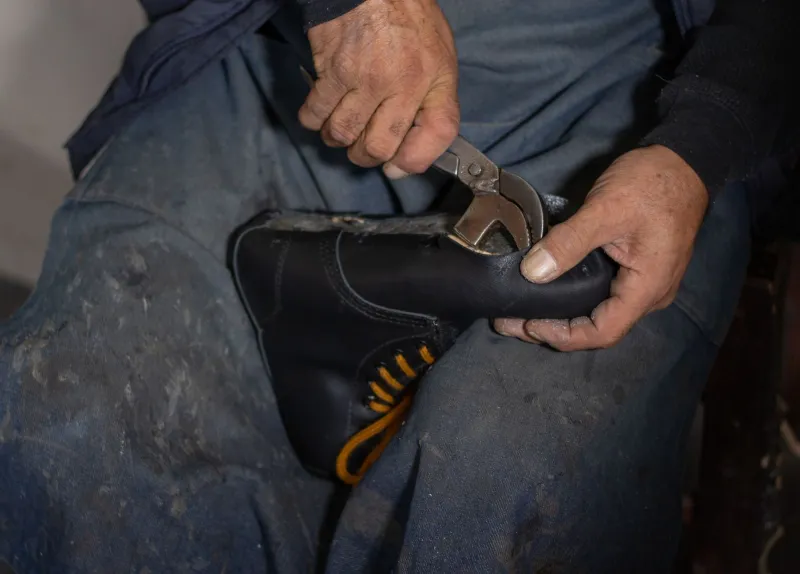
Perhaps the most revealing dimension of British shoe care culture is not the daily maintenance ritual but the philosophy that governs repair. A gentleman who returns his shoes to a cobbler at the first sign of heel wear — who re-soles before the welt is threatened, who replaces the toe tap before it wears through — is not being precious. He is being intelligent.
The distinction between a shoe that has been repaired and one that has been neglected until repair is no longer viable is the distinction between stewardship and mere possession. Ownership, in the British tradition, has always implied obligation. One does not simply acquire a fine object; one accepts responsibility for its continuation.
This is why the question of whether to resole a beloved pair of shoes is never really a financial one, even when it is framed as such. The true question is one of commitment: is this an object worth perpetuating, or merely one that has been used up? For those who purchase with genuine discernment — who select their footwear not by price alone but by the quality of construction, the integrity of the leather, the reputation of the maker — the answer is almost always the former.
A Goodyear-welted shoe, properly maintained and periodically resoled, is not a depreciating asset. It is a maturing one. The leather softens to the precise contours of its wearer's foot. The upper develops a patina that no factory process can replicate. The shoe becomes, over time, something genuinely irreplaceable — a record of where its wearer has stood, and how.
Reading the Room
There is a social literacy to all of this that operates below the level of conscious thought. Those who care for their shoes tend to recognise the same quality in others. A well-maintained pair of Oxfords at a business meeting communicates something that a poorly-kept equivalent does not: that the wearer applies the same standard of considered attention to his professional commitments as he does to his personal possessions.
This is not snobbery. It is pattern recognition. The person who maintains their shoes well is, in most cases, the same person who honours appointments, reads contracts carefully, and follows through on undertakings. The correlation is not absolute, but it is observed often enough to have earned its place in the informal grammar of British professional life.
The Inheritance of Good Habits
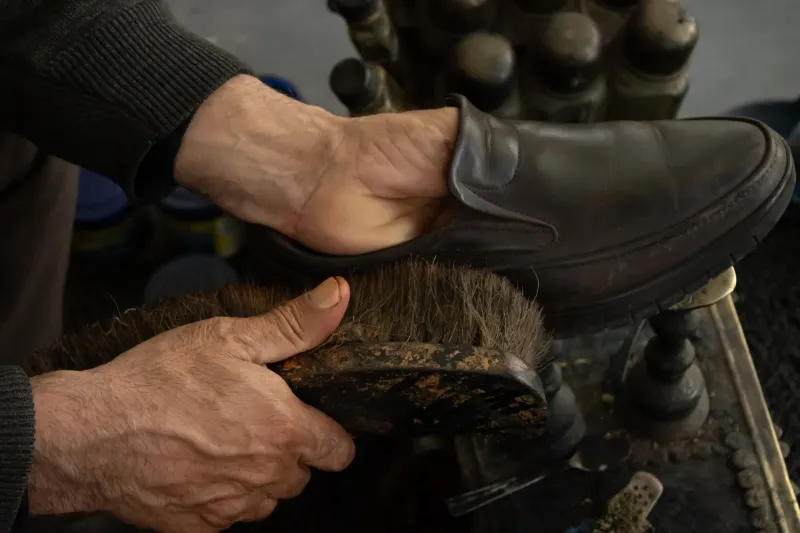
The most enduring dimension of British shoe care culture is its transmission across generations. The ritual of watching a father or grandfather tend his shoes — laying out the brushes, selecting the cream, working the leather with a patience that seemed almost ceremonial — is one that many men of a certain generation carry with them as a formative memory.
What was transmitted in those moments was not merely technique. It was an orientation toward material things: that quality deserves respect, that maintenance is not a chore but a practice, and that the objects we choose to surround ourselves with reflect, in some measure, who we aspire to be.
At Russell & Bromley, this understanding underpins everything. The shoes we offer are made to be maintained, to be repaired, to be worn with the confidence that comes from knowing they will respond to care in kind. A scuff, in this light, is not a failure. It is an invitation — to engage, to restore, and to demonstrate, in the quietest possible way, that one takes seriously the things one has chosen to own.