What a Cobbler Knows: The Hidden Diagnosis Written Into Every Worn Sole
There is a particular kind of intelligence that lives in a cobbler's hands. It is not the intelligence of formal education or digital precision, but something older and more intimate — a literacy developed over decades of examining, dismantling, and restoring the shoes that carry British life forward. When a master cobbler takes your shoes from across the counter, turns them sole-upward, and tilts them towards the light, they are not simply assessing damage. They are reading a document.
That document, written in compressed leather and abraded welting, tells them a great deal. About the way you walk. About the surfaces you traverse. About whether you have been caring for these shoes or merely wearing them. And, perhaps most critically, about whether what stands before them is worth saving.
The Sole as Biography
Wear patterns are, in the vocabulary of the professional cobbler, one of the most informative things a shoe can offer. An outer heel worn at a steep diagonal suggests a supinated gait — a tendency to roll outward with each stride. Wear concentrated beneath the ball of the foot indicates someone who spends long hours standing, or who favours a forward-weighted posture. Scuffing along the inner toe box speaks to a slightly inward foot strike, common among those who walk quickly across hard urban surfaces.
"You can tell within thirty seconds whether someone looks after their shoes or whether they've been neglecting them," explains one master cobbler working from a long-established workshop in central London. "But more than that, you can tell whether the shoe itself was worth looking after in the first place. A well-constructed shoe wears honestly. A poorly made one just collapses."
This distinction — between a shoe that ages with integrity and one that simply deteriorates — is central to the cobbler's diagnostic process. Premium footwear, built on a proper last with a Goodyear welt and full-grain leather, tends to fail in predictable, repairable ways. The sole thins. The heel compresses. The welt may begin to separate at a stress point. These are structural conversations, not structural failures. They invite intervention.
Cheaper construction, by contrast, tends to fail comprehensively. The upper delaminates from the insole board. The midsole crumbles. The cement bond — rather than a stitched welt — gives way entirely. In these cases, even the most skilled cobbler faces an uncomfortable truth: some shoes are not worth the cost of their own resurrection.
The Ethics of Restoration
The question of repair versus replacement is one that master cobblers consider with genuine seriousness. It is, at its core, an ethical question as much as a practical one — touching on sustainability, craftsmanship, and the responsibility that comes with owning something of quality.
"I won't resole a shoe that's going to fall apart in three months," says a cobbler whose Northampton workshop has served customers for over forty years. "It's not honest. If the upper is cracked through to the lining, if the last has lost its shape, if the leather has gone papery — I'll tell the customer plainly. There's no value in spending good money to extend a poor shoe's life by six weeks."
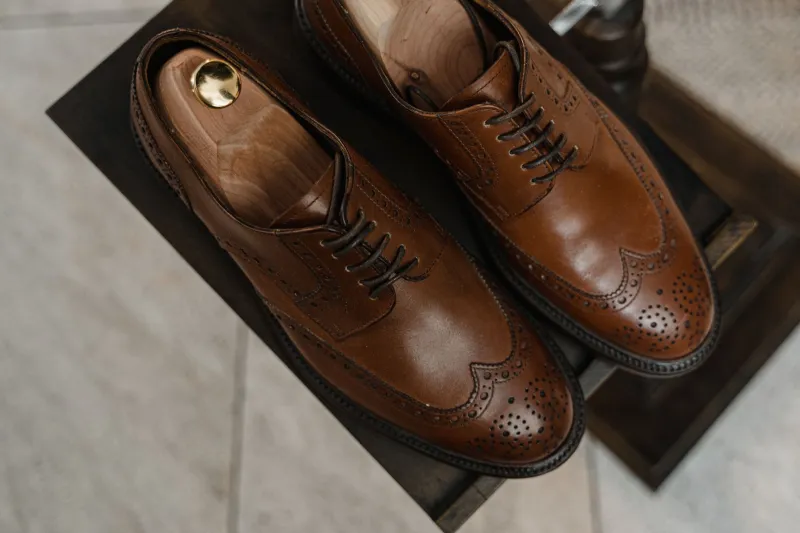
Conversely, the same craftsman will invest considerable time and skill in a well-made shoe that has simply been worn hard. A pair of English-made Oxfords with a compressed heel, a thinning sole, and minor upper scuffs represents, to his eye, not a failure but an opportunity. New half-soles stitched through the original welt. A rebuilt heel stack. A careful clean, condition, and polish of the upper. The result is a shoe that, in many respects, performs better than it did when it left the shop floor.
This is the central promise of quality footwear investment: the capacity to be renewed. It is a promise that cheap construction cannot make.
What Cobblers Wish Customers Understood
Ask any experienced cobbler what frustrates them most, and the answer tends to be consistent: customers who wait too long. A heel worn past its top-piece and into the heel block is a straightforward repair if caught early. Left until the block itself is compromised, it becomes a structural reconstruction — more expensive, more time-consuming, and occasionally impossible to execute without visible evidence of the intervention.
Similarly, a welt that has begun to separate at the toe — often the first point of stress — can be reglued and reinforced within minutes if brought in promptly. Ignored for another season, the separation travels the length of the shoe, and what was a minor repair becomes a full resole.
"People think they're saving money by waiting," observes a cobbler based in Edinburgh's New Town. "But every week you leave a damaged shoe unworn in a wardrobe, or worse, keep wearing it damaged, you're narrowing the options available to me. Early intervention is always cheaper. Always."
This counsel applies equally to the upper. Leather that has dried and begun to crack along the toe or vamp can often be restored with professional conditioning and careful attention. Once a crack deepens through the grain and into the corium — the inner fibrous layer of the hide — it cannot be fully reversed. The leather has lost its structural memory.
The Invisible Craft of the Lasting Room
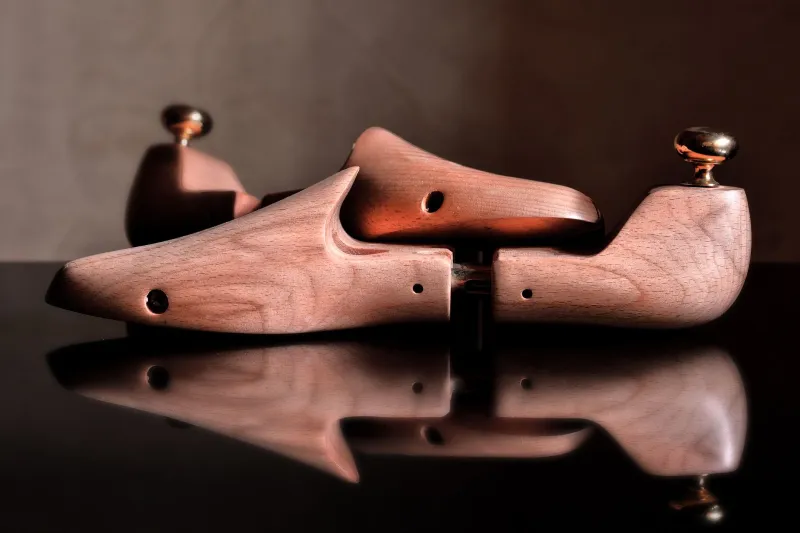
Beyond diagnosis and repair, there is a dimension of the cobbler's work that most customers never consider: the preservation of shape. A well-made shoe is built around a last — a precise wooden form that gives the shoe its character. Over time, and particularly if shoes are stored without trees, that shape can migrate. The toe box collapses. The heel counter softens. The waist loses its subtle architectural curve.
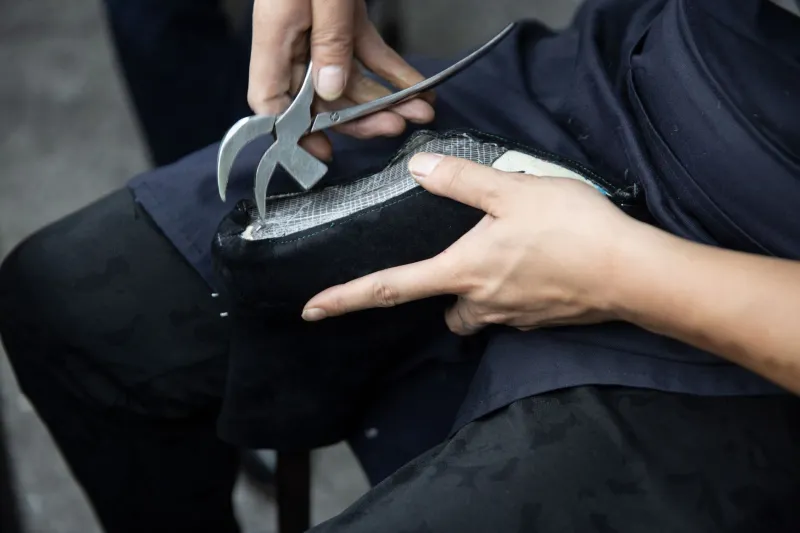
A skilled cobbler can, with the application of lasting pincers, moisture, and careful manipulation, coax a distorted shoe back towards its original form. It is painstaking work, invisible when done well, and it speaks to a dimension of the craft that lies entirely outside the customer's view.
To watch a master cobbler work is to understand something important about the shoes you wear: they are not static objects. They are dynamic, responsive, and — if they are good enough — capable of a second life that rivals the first.
Choosing Your Cobbler as Carefully as Your Shoes
For the discerning customer, the relationship with a skilled cobbler is as important as the relationship with a trusted shoemaker. This is not hyperbole. A fine pair of shoes, improperly resoled with an ill-fitting unit sole or a poorly matched leather, can be diminished irreversibly. The wrong heel height, even by two millimetres, alters the shoe's balance. A sole attached without respecting the original welt construction compromises the shoe's flexibility and longevity.
Ask questions. Enquire about the materials a cobbler stocks. A workshop that carries both leather and rubber soles, that holds welting cord in multiple weights, and that can source replacement heel blocks in appropriate grades is a workshop that takes its work seriously.
The shoes you invest in deserve nothing less. And in understanding what a cobbler sees when they look at your footwear, you will find yourself looking at it differently too — with the attentiveness that fine things have always warranted.