The Quiet Infrastructure of the Considered Wardrobe: A Case for the Shoe Tree
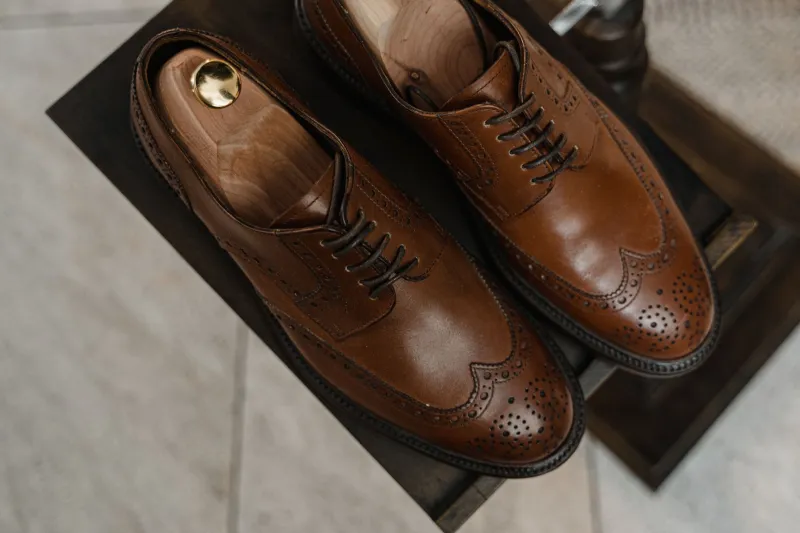
There is a particular kind of satisfaction reserved for those who open their wardrobe and find everything in its proper order. Suits hung with care, shirts aligned by shade, and at the base of it all, shoes resting on their trees — upright, composed, and quietly restored to the shape they were always meant to hold. It is a sight that speaks not merely of tidiness, but of a deeper philosophy: that the things we invest in deserve the infrastructure to endure.
The shoe tree is not a glamorous object. It does not announce itself. It performs its work in darkness, behind closed doors, without acknowledgement. Yet for anyone who takes British dressing seriously — who understands that a well-made shoe is as much a long-term commitment as it is a daily utility — the shoe tree is indispensable. Its absence, in certain circles, says rather more than its presence.
Form Follows Function: What a Shoe Tree Actually Does
At its most mechanical, a shoe tree serves a straightforward purpose: it holds a shoe in its correct shape while it is not being worn. Leather, for all its supple elegance, is a biological material. It responds to moisture — the perspiration absorbed during a day's wear — by softening, and if left unsupported, it will dry into a distorted version of its former self. Creases deepen. The toe box collapses. The heel counter begins to lose its structure. Over weeks and months, a shoe left to its own devices will age not gracefully, but ungracefully.
A well-fitted shoe tree counteracts this process with quiet efficiency. By filling the shoe from within, it absorbs residual moisture, maintains the tension of the upper leather, and prevents the formation of permanent creases across the vamp. The result, over years of consistent use, is a shoe that retains its original silhouette — the very silhouette that made it worth purchasing in the first instance.
The Matter of Wood: Cedar, Beech, and the Hierarchy of Materials
Not all shoe trees are created equal, and the material from which they are fashioned matters considerably. Plastic trees, while adequate for short-term travel or occasional use, lack the absorbent qualities that make wood so effective. They hold shape without drawing moisture, and in doing so, address only half the problem.
Among wooden options, aromatic red cedar holds a particularly distinguished reputation. Its open grain structure makes it naturally hygroscopic — it draws moisture from the leather efficiently and releases it slowly into the surrounding air. Cedar also carries a mild, pleasant scent that discourages the development of odour within the shoe over time. For a shoe worn regularly in a British climate, where dampness is rarely far away, this combination of properties is especially valuable.
Beech wood trees, denser and less fragrant, offer excellent structural rigidity and are often found in higher-grade European shoemaking traditions. They hold their form with precision and are less prone to splitting under the tension of a well-sprung shoe. For those with particularly structured footwear — Oxford brogues, Goodyear-welted boots, or formal court shoes — the firmness of beech can be preferable.
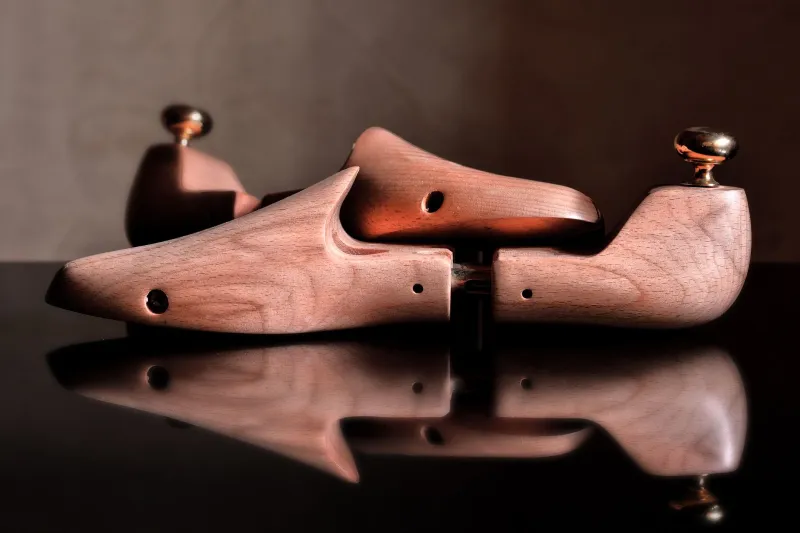
The finest shoe trees are shaped to approximate the last on which the shoe was originally made. A full-toe tree, which fills the entire forepart of the shoe rather than simply the ball and heel, offers superior support and is generally considered the appropriate choice for any shoe of genuine quality.
Ritual and Routine: The Discipline of Immediate Insertion
The effectiveness of a shoe tree depends entirely upon when it is inserted. Introduced immediately after a shoe is removed — while the leather is still warm and marginally pliable from wear — the tree works with the material rather than against it. It eases the upper back into position before the leather has had the opportunity to set in a compromised form.
Left until the following morning, or inserted only occasionally, a shoe tree offers diminishing returns. The leather has already begun to cool and contract. The creases have already begun to set. The tree will still provide some benefit, but the cumulative advantage of consistent, immediate use is lost.
This is why the ritual of removing one's shoes and inserting the trees in the same motion — unhurried, deliberate, part of the natural rhythm of an evening — is something that separates the genuinely considered dresser from the merely aspirational one. It takes no more than thirty seconds. Its effect accumulates over years.
Storage as Statement: What the Cupboard Reveals
In British culture, there has long been a tradition of judging character by the things that are not on display. The state of one's correspondence. The condition of one's tools. The organisation of a kitchen drawer. These are not public performances; they are private disciplines, observed only by the person practising them.
The shoe cupboard belongs to this tradition. A row of shoes resting on their trees, arranged with some regard for order, represents a commitment to the invisible work of maintenance. It suggests that the wearer does not simply acquire fine things, but understands the obligation that accompanies them — the responsibility to preserve what has been made with skill and purchased with discernment.
This is not vanity. It is, in the truest sense, respect: for the craftspeople whose work lives within each pair, for the materials that were selected and treated with care, and for the investment — financial and personal — that a quality shoe represents.
Choosing the Right Tree for Your Shoes
For those new to the practice, the principle is simple: invest in a shoe tree of comparable quality to the shoe it will inhabit. A full-lasted cedar tree, properly sized, is the appropriate companion for a Goodyear-welted Oxford or a well-constructed ankle boot. Split-toe trees — which allow the forepart to flex slightly as the tree is inserted — reduce the risk of applying undue lateral stress to the upper, and are particularly well-suited to shoes with a narrower toe box.
Sizing matters considerably. A tree that is too small will fail to tension the leather adequately; one that is too large risks stretching the shoe beyond its intended dimensions. Most reputable shoemakers and footwear specialists offer guidance on matching tree size to shoe size, and it is worth seeking this counsel rather than relying on approximation.
The Long View
A shoe tree is, ultimately, an act of faith in the future. It is the acknowledgement that a well-made shoe is not a disposable object but a lasting one — that with the right care, it will still be worth wearing in a decade, and perhaps two. In an era that frequently favours the disposable over the durable, there is something quietly radical about this position.
The British tradition of dressing well has always rested on this understanding: that quality is not simply about what one purchases, but about what one does with it afterwards. The shoe tree, humble and unsung, is the most honest expression of that tradition. It costs relatively little. It asks only for consistency. And in return, it preserves something that no amount of future spending can replicate — the original integrity of a shoe made to last.