Polish, Patience, and Purpose: The Meditative Art of Caring for Fine British Shoes
There is a particular kind of Sunday morning that belongs, in the British imagination, to the ritual of shoe care. A cloth laid across the kitchen table, tins of wax arranged with quiet intention, and a brush worn soft through years of service. It is an unremarkable scene, and yet it carries within it something genuinely profound — a conversation conducted without words between the person who owns a shoe and the person who made it.
In an age that rewards speed and disposability, the deliberate slowness of proper shoe maintenance has come to feel almost countercultural. And perhaps that is precisely why it matters.
The Maker's Expectation
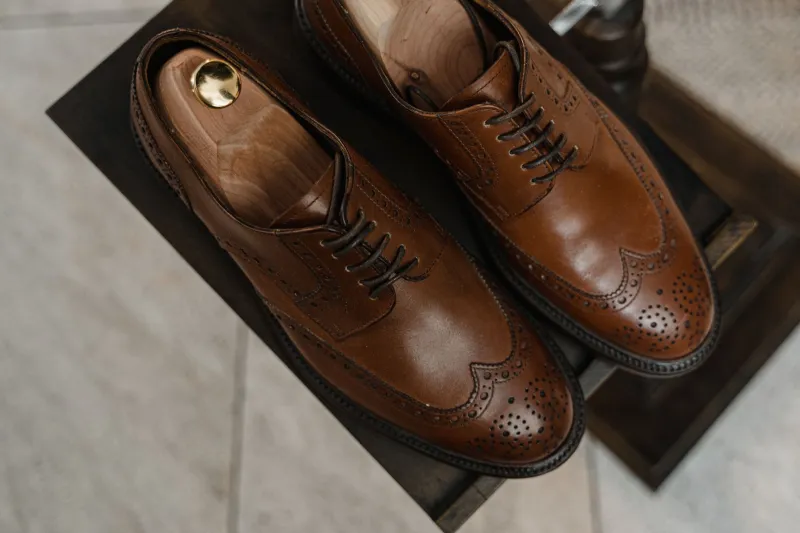
When a British shoemaker draws a lasting over a shaped last, applies welt and sole with painstaking precision, and burnishes leather to its first lustre, there is an implicit understanding built into the work: that this shoe will be looked after. The finest Northampton-made footwear, constructed from full-grain calf or vegetable-tanned hide, is designed not merely to survive neglect but to flourish under attention. The leather is chosen because it responds — to conditioning oils, to the warmth of a polishing cloth, to the patient application of wax over time.
To ignore that responsiveness is not simply to risk premature wear. It is to misunderstand what the shoe fundamentally is. Fine footwear is not a static object; it is a material that continues to develop throughout its life, acquiring depth of colour, suppleness, and a patina that no factory process can replicate. That development, however, requires a partner. The owner is not merely a custodian — they are a collaborator in the shoe's ongoing story.
The Ritual Itself
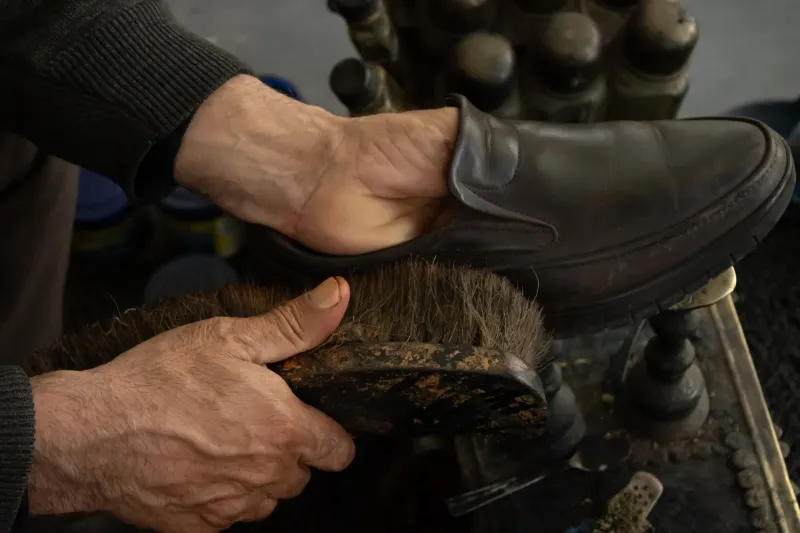
Begin with a horsehair brush. The first pass removes surface dust and dried mud, restoring the leather's ability to breathe and receive what comes next. There is something grounding in this initial act — a clearing away, a preparation. It asks for presence rather than haste.
Conditioning follows, and here the quality of one's chosen product matters considerably. A good leather conditioner, applied sparingly with a soft cloth and worked into the grain with circular motions, replenishes the natural oils that heat and dryness deplete. Neglected leather cracks along the flex points — the toe box, the vamp, the quarters — not because it is inferior, but because it has been left without nourishment. This step, more than any other, is an act of care in the truest sense: attending to something's fundamental needs before they become visible problems.
The wax polish that follows is where craft meets craft. A quality cream or wax, applied in thin, even layers and buffed to a shine with a clean brush, does not merely create surface gloss. It feeds the leather, fills minor surface abrasions, and gradually builds the kind of deep, complex finish that distinguishes a shoe that has been properly loved from one that has merely been cleaned. The British tradition of 'spit-shining' — a technique borrowed from military dress codes — takes this further still, using moisture and friction to create a mirror finish on the toecap that speaks of discipline and dedication in equal measure.
What the Practice Reveals
Psychologists who study mindfulness often point to repetitive, sensory tasks as among the most effective means of achieving a calm, focused state. The rhythmic motion of a polishing brush, the scent of beeswax and leather, the gradual emergence of a shine beneath one's hands — these engage the senses fully whilst asking nothing of the analytical mind. It is, in the most unpretentious sense, a form of meditation.
But it is also a form of self-disclosure. How we treat the things we own reveals something about how we understand value. A person who polishes their shoes weekly is making a statement — not for public consumption, necessarily, but for themselves — about the relationship between quality and stewardship. They are acknowledging that a well-made thing deserves to be maintained, and that the effort of maintenance is itself worthwhile.
In British professional culture, this has long been understood instinctively. The solicitor who arrives with immaculate brogues, the architect whose Chelsea boots are buffed to a quiet lustre, the consultant whose Oxford shoes carry the depth of colour that only comes from years of careful attention — these are individuals who understand that their footwear communicates something about their standards before a single word is spoken.
Storing with Intention
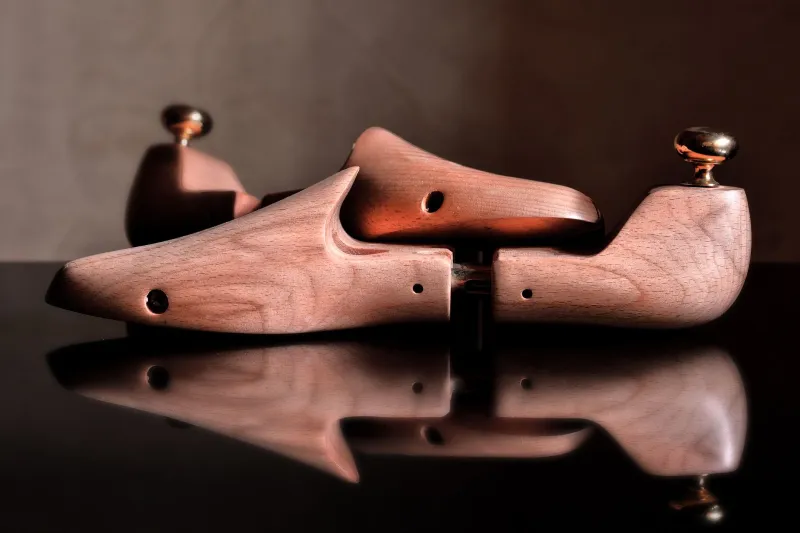
The ritual does not end with polish. Proper storage is the final, often overlooked act in the cycle of care. Cedar shoe trees, inserted whilst the leather is still warm from wear, serve a dual purpose: they absorb moisture and perspiration, and they restore the shoe's original shape as it dries, preventing the creasing and distortion that shortens a shoe's life considerably.
Stored in cotton dust bags or on open shelving away from direct heat, quality shoes can rest between wearings without deteriorating. This, too, is a form of respect — acknowledging that the shoe requires space and air, not compression in the back of a wardrobe.
Rotation, long advocated by those who understand footwear, allows each pair sufficient time to dry fully between wearings. A shoe worn daily without rest ages prematurely; one given two or three days between outings repays the consideration with years of additional service.
A Conversation Worth Having
There is something quietly radical about choosing to maintain rather than replace — to invest time in the preservation of quality rather than surrendering to the convenience of disposal. In this sense, shoe care is not simply about footwear. It is a practice that reasserts the value of craftsmanship in a world that often treats the handmade and the durable as inconvenient anachronisms.
The shoemakers of Northampton, the tanneries of Somerset, the craftspeople who dedicate years to mastering skills that cannot be automated — they produce work that is worthy of the attention. To polish a well-made British shoe is to honour that work, to extend the conversation that began on the maker's bench and continues with every wearing, every conditioning, every careful application of wax.
It is, in the end, a practice that says something simple and important: that quality deserves to last, and that we are willing to play our part in ensuring that it does.