Every Mark Tells a Story: The Art of Reading What Your Shoes Remember
There is a particular kind of honesty that only leather possesses. Unlike the fibres of a suit or the weave of a shirt, leather yields to pressure, absorbs the warmth of the body, and deforms — gradually, faithfully — in response to the unique mechanics of its wearer. A well-made shoe, given sufficient time and use, ceases to be a generic object. It becomes specific. It becomes yours.
This transformation is not merely sentimental. The wear patterns etched into a sole, the creases folded into a toe box, the compression visible across a heel counter — these are forensic details, each one corresponding to something real about how a person moves through the world. To understand them is to understand something about yourself that no mirror can reveal.
The Heel: Where Character Begins
Shoemakers and orthopaedic specialists alike will tell you that the heel is the first place to look. Its wear pattern is among the most diagnostic features of a shoe's biography.
A heel worn predominantly on the outer rear edge — the lateral corner — is the most common pattern in Britain, and it reflects a perfectly natural gait cycle in which the foot strikes the ground on its outside before rolling inward. But the degree of this wear matters considerably. Modest lateral wear, even across the heel, suggests a balanced, efficient stride. Pronounced outer-edge erosion, particularly when asymmetric between left and right, may point to supination: a tendency to walk on the outside of the foot that places undue strain on the ankle and knee over time.
Conversely, wear concentrated on the inner edge of the heel — the medial corner — suggests overpronation, wherein the foot rolls excessively inward upon landing. This pattern is frequently observed in those who spend long hours on their feet, or who walk considerable distances on hard urban surfaces. London's stone pavements and uneven Victorian kerbs are not kind to a neutral stride.
Perhaps most telling of all is the heel worn flat and evenly across its entire surface. This is the mark of the deliberate walker — someone who places their foot with measured intention, often a person accustomed to formal environments where composure extends even to the manner of one's step.
The Sole: A Map of Daily Life
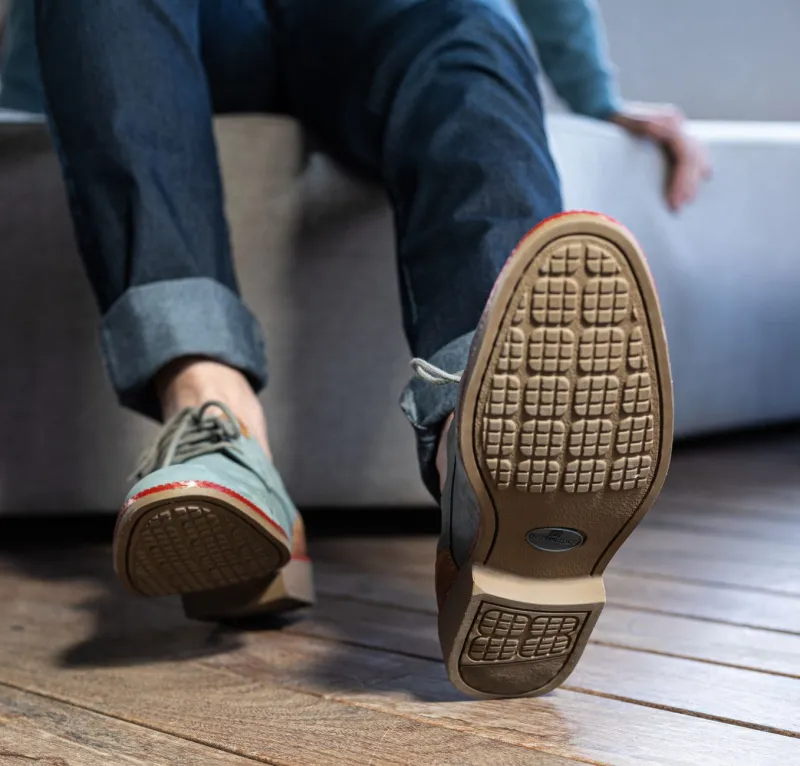
If the heel speaks to gait mechanics, the sole speaks to geography and habit. The ball of the foot — that broad metatarsal region just behind the toes — bears the greatest load during the push-off phase of walking, and its wear reveals how energetically or cautiously a person propels themselves forward.
Deep, concentrated wear beneath the first metatarsal head (the joint behind the big toe) is the signature of an active, forward-driven stride. It is the sole of someone who moves with purpose: the morning commuter navigating Liverpool Street, the professional crossing from meeting to meeting across Mayfair's Georgian squares.
Wear spread more evenly across the ball of the foot tends to indicate a slower, more deliberate pace — not lethargy, but consideration. One finds this pattern in the shoes of those who spend their days in thought-intensive environments, where physical movement is secondary to mental engagement.
The toe area of the sole, meanwhile, is often overlooked but quietly revealing. Scuffing concentrated at the very tip of the sole — beneath the toes rather than the ball — can indicate a shuffling gait or, more commonly, fatigue. It is the wear pattern of late afternoons and long weeks, accumulated invisibly over months until the leather itself bears witness.
The Upper: Where Lifestyle Leaves Its Imprint
Beyond the sole, the upper of a shoe carries its own archive. The creases that form across the vamp — that broad expanse of leather covering the top of the foot — are governed by the precise shape of the wearer's foot and the flexion point of their stride. Deep, singular creases suggest a foot that bends cleanly at one point; multiple, fanned creases indicate a more complex flex, often associated with a broader forefoot or a tendency to grip the shoe with the toes.
The condition of the quarters — the leather panels at either side of the shoe — tells a different story. Abrasion on the inner quarter, just above the arch, is frequently the mark of a person who crosses their legs habitually when seated; the leather of one shoe repeatedly brushes against the other. It is a small detail, but it places the wearer unmistakably in certain settings: boardroom chairs, club armchairs, the dining tables of long London lunches.
Creasing at the heel counter — the stiffened back portion of the shoe — is among the more melancholy forms of wear, as it suggests the shoe has been forced on and off without the use of a shoehorn. The counter buckles, the leather splits internally, and the structural integrity of the shoe is quietly compromised. It is, if one is being candid, the wear pattern of impatience.
Wear as Autobiography, Not Damage
There is a cultural tendency, particularly in Britain, to regard worn shoes with a certain ambivalence — to see the marks of use as evidence of neglect rather than engagement. This misreads the nature of quality footwear entirely.
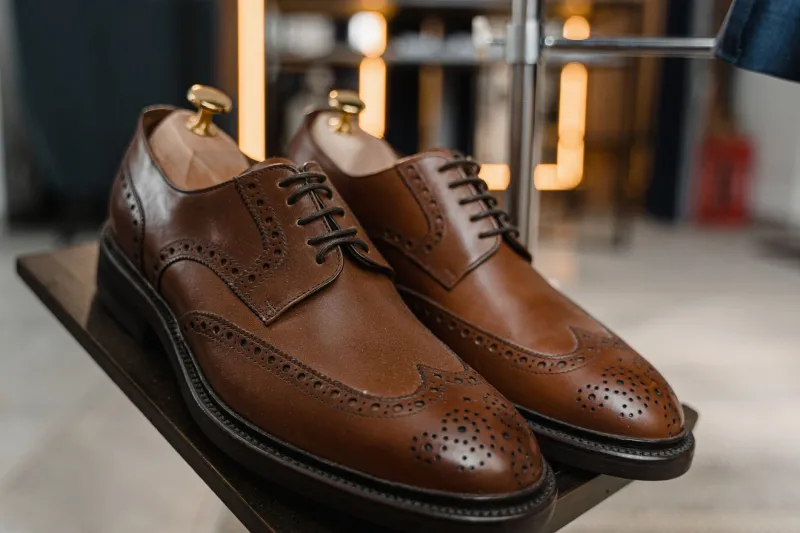
A shoe made to a high standard — from full-grain leather, with a Goodyear-welted or hand-stitched construction — is designed to be resoled, recrafted, and restored. The upper, properly cared for, outlasts many sole replacements. The wear patterns that accumulate are not terminal; they are chapters. A cobbler of skill can renew the mechanical function of a shoe while leaving its personal history intact in the leather above.
To study your own shoes in this spirit is not vanity. It is attentiveness. The marks pressed into their leather represent the actual texture of your days: the distances walked, the rooms entered, the hours stood, the journeys made. No photograph captures this. No diary entry records it with the same fidelity.
The Educated Eye
Developing the habit of examining your shoes — genuinely examining them, rather than merely polishing them — rewards patience with insight. Hold a shoe at eye level against a good light source and observe the sole in profile. Note which areas catch the light flatly and which have worn to a different plane. Turn the shoe and study the heel from behind: is the wear centred, or does it favour one side?
Over time, and particularly if you own several pairs that you rotate conscientiously, you will begin to notice consistencies. The same heel wear appears across every pair. The same crease forms at the same point on every vamp. These repetitions are not coincidences — they are the signature of your particular body moving through its particular life.
The finest shoes are those that record this signature most honestly, because they are made from materials supple enough to yield to it and durable enough to preserve it. Cheap footwear wears out before the story is fully told. Quality footwear holds the narrative long enough for it to become something worth reading.
In this sense, a well-chosen shoe is not merely an accessory. It is, in the most literal terms, a record of where you have been — and, for those who know how to look, a quiet and revealing portrait of who you are.