Sole Signals: What British Footwear Quietly Communicates About Who We Are
There is a particular kind of attention that the British pay to feet. Not the overt, fashion-forward scrutiny one might encounter in Milan or New York, but something altogether more restrained — a glance held a fraction longer than necessary, a subtle recalibration of expectation. In a culture that prizes understatement and distrusts the overtly declarative, shoes have become one of the few remaining arenas in which genuine character is legible to those who know how to read it.
This is not vanity. It is, rather, a form of social literacy that has developed over centuries — one in which the cut of a welt, the grain of a leather, or the precise degree of polish on a cap toe communicates volumes that conversation rarely could.
The Grammar of the British Shoe
To understand why footwear carries such weight in British social life, one must first appreciate the peculiar relationship this nation has always maintained with visible hierarchy. Unlike cultures in which wealth announces itself through logos or extravagance, British distinction has traditionally operated through restraint — through knowing what not to wear as much as what to wear.
The Northampton-made Oxford, for instance, has never been merely a shoe. Its clean lines, its closed lacing, its deliberate absence of ornament all speak to a particular understanding of formality — one that values discipline over display. To wear such a shoe correctly polished, on the appropriate occasion, is to demonstrate familiarity with a set of conventions that cannot be easily purchased or quickly acquired. It signals, in essence, that one has been paying attention for rather a long time.
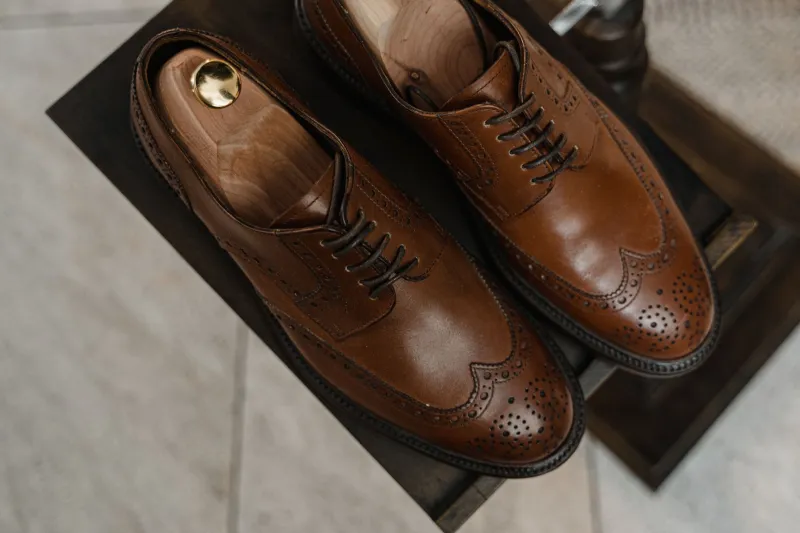
Conversely, the brogue — with its decorative perforations and its origins in the peat bogs of Ireland and the Scottish Highlands — carries an entirely different freight. Once considered too rural for urban wear, it has long since been absorbed into the mainstream of British professional dress, yet it retains a certain studied ease, a suggestion that its wearer is comfortable moving between worlds. The country house and the city office. The formal and the convivial. It is the shoe of someone who does not feel the need to choose.
Aspiration and Its Discontents
One of the more revealing dynamics in British shoe culture is the distance between aspiration and authenticity — between the person who has arrived at their choices through genuine conviction and the person who has arrived at them through a desire to be perceived in a particular light.
This distinction is rarely spoken aloud, yet it is almost universally felt. The new acquisition worn with excessive care, as though the wearer is conscious of being watched, tends to betray itself. The shoe that has been broken in over years — that bears the particular creasing and patina of a life actually lived in it — communicates something altogether more settled. There is, in the British context, a deep suspicion of the pristine, particularly when it appears in contexts where experience ought to have left its mark.
This is why the genuinely well-dressed Briton often appears, to the untrained eye, slightly underdressed. The deliberate avoidance of the obviously new, the preference for quality that has been allowed to develop its own character — these are the hallmarks of someone who understands that true distinction is cumulative rather than immediate.
Gender, Formality, and the Shifting Codes
The conversation that shoes conduct is not, of course, identical across genders. The codes governing men's footwear in Britain have remained relatively stable for several generations — variations in heel height, toe shape, and degree of broguing providing a narrow but legible spectrum of signals. Women's footwear, by contrast, has always operated within a far more complex semiotic field, one in which the relationship between formality and femininity has been subject to continual renegotiation.
The block-heeled court shoe, for instance, occupies a particular position in British professional life — authoritative without being aggressive, formal without being restrictive. It has long functioned as a kind of visual shorthand for competence within institutional settings: the law, finance, government. Yet the same shoe worn in a creative or academic context might read entirely differently — as a deliberate invocation of a certain kind of establishment seriousness, or as an ironic commentary upon it.
This ambiguity is not a flaw in the language of footwear; it is, rather, evidence of its sophistication. The meaning of any shoe is always partly determined by the context in which it appears, the body that wears it, and the history — personal and cultural — that surrounds it.
Tradition as Conviction, Not Costume
Perhaps the most important distinction in British shoe culture is the one between wearing tradition as genuine conviction and wearing it as costume. The former requires a certain confidence — an ease with historical forms that comes not from nostalgia but from a genuine belief in their continuing relevance. The latter tends to reveal itself through excess: the too-perfect ensemble, the studied archaism, the sense that the wearer is performing a role rather than simply inhabiting their own life.
The finest British shoemaking has always understood this. The great Northamptonshire workshops — many of which have been producing shoes by hand for well over a century — have never sought to make footwear that shouts. Their craft is in the service of longevity, of wearability, of the kind of quiet confidence that deepens rather than diminishes with time. A shoe built to this standard does not need to announce itself. It simply endures, accumulating meaning as it goes.
This is why, for those who understand the conversation, a well-chosen shoe from a maker with genuine heritage communicates something that no amount of conspicuous expenditure can replicate. It speaks not of wealth, but of judgement. Not of fashion, but of understanding. Not of where one wishes to be seen, but of who one actually is.
The Last Honest Signal
In an age in which so much of personal presentation has become managed, curated, and subject to the distortions of digital performance, the shoe retains a remarkable capacity for honesty. It is, after all, the thing furthest from the face — the detail least likely to be consciously considered in the moment of social interaction, and therefore the most likely to reflect genuine habit and genuine character.
The Briton who has spent years developing their relationship with quality footwear does not think particularly hard about what their shoes communicate. They simply choose what they know to be right — and in doing so, they say everything that needs to be said.
That, in the end, is the most eloquent form of self-expression available: the kind that requires no explanation whatsoever.