The Second Life: Why the Ability to Be Resoled Is the Truest Mark of a Fine Shoe
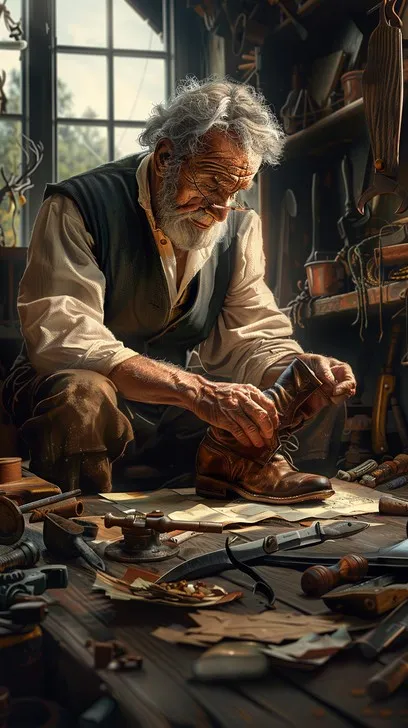
Photo: cobbler workshop resoling leather shoes craftsman hands bench, via images.stockcake.com
In an unassuming workshop in Northampton, a pair of twenty-year-old Oxfords sits on a bench with its sole stripped away, the welt exposed like the ribs of a small ship. A craftsman will spend several hours returning the shoe to something close to its first day. The upper — the part that carries the character, the creases, the memory of its wearer — will not be replaced. It will be saved.
This is the resole economy: the largely invisible network of workshops, suppliers, and archives that constitutes the true infrastructure of British footwear heritage. It receives nothing like the attention of the runway or the retail floor. It deserves considerably more.
The Goodyear Welt: A Contract With the Future
The technical heart of this economy is the Goodyear welt, the construction method in which the upper, the lining, and the sole are stitched to a rib of leather running around the shoe's perimeter. Its genius is not merely durability but reversibility. A welted shoe is, by design, a shoe that consents to be repaired. The sole is a component, not a commitment.
Contrast this with a shoe whose sole is merely glued to its upper. However handsome at purchase, it has no second life to offer. When it wears, it is finished. This is the quiet test that separates premium footwear from expensive footwear — and price tags do not reliably tell you which is which.
The Network Behind the Bench
Resoling a fine shoe depends on a supply chain most customers never see. Specialist merchants still stock legacy materials: oak bark-tanned leathers cured in pits over many months, sole leather of a thickness and density that few volume factories demand, heel builds and stitching techniques unchanged in a century. Some of these suppliers number in single figures nationally. Their survival is inseparable from the survival of the craft itself.
Then there are the archives — the factories and workshops that retain the lasts, the patterns, and the technical drawings of shoes made decades ago. A re-craft is not a generic repair; it is the restoration of a specific object using knowledge specific to that object. When a customer sends back a beloved pair for renewal, the workshop is drawing on institutional memory that cannot be improvised.
The Economics of the Second Life
The arithmetic rewards attention. A welted shoe might cost several times the price of a bonded one at purchase. But over twenty years, the bonded shoe is replaced four or five times, while the welted shoe absorbs perhaps two or three resoles — each a fraction of the cost of replacement. The premium shoe is not a luxury indulgence; it is, properly accounted, the cheaper option.
There is a subtler economy at work too. Every resole sustains a workshop, trains an apprentice, and keeps a materials merchant in business. The customer who repairs rather than replaces is not merely saving money; they are underwriting the ecosystem that makes repair possible for the next generation.
Repairability as the Real Logo
We would go further: in an age of saturated branding, the most honest indicator of a shoe's quality is not the name on the insole but the answer to a single question — can it be resoled? A maker confident in their craft builds for the second life, because they expect the shoe to have one. A maker confident only in their marketing builds for the first season.
The discerning customer would do well to ask that question before purchase, and to use the answer afterwards. Break in a fine shoe, wear it honestly, and when the sole finally thins, send it back to the bench. What returns is not simply a repaired shoe. It is proof that some things in British life are still built — and maintained — to endure.