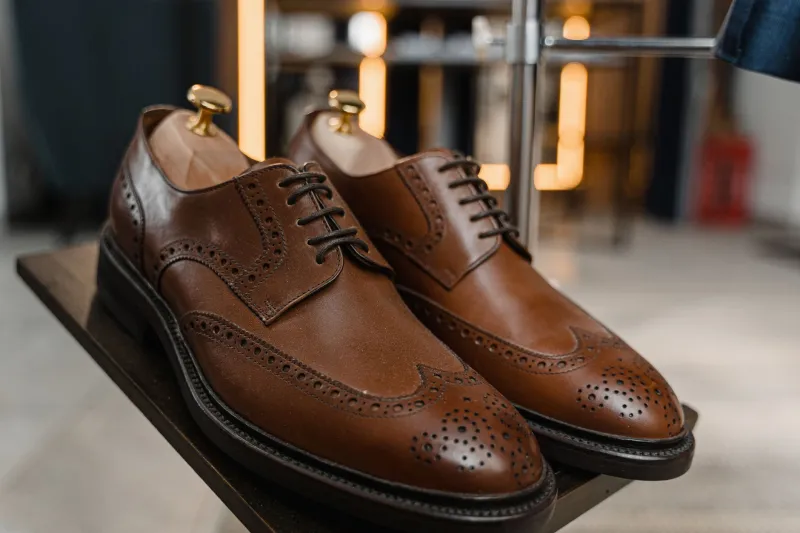
The Autobiography of Wear: What Britain's Master Cobblers Read in the Shoes You Bring Them
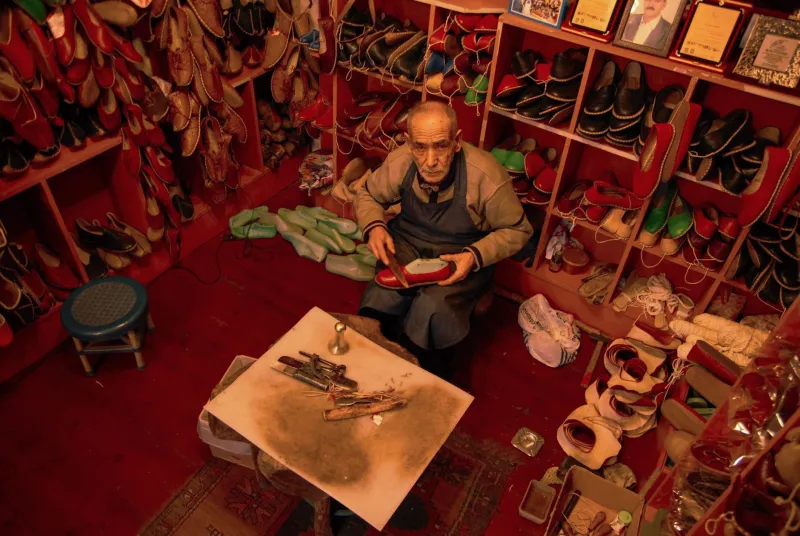
On a narrow street in Marylebone, behind a door that has not changed in thirty years, a man named Gerald holds a brogue to the light and says nothing for a long moment. The shoe is a good one — Goodyear-welted, calf leather, clearly well cared for in its time. But the time has told on it. The left heel is worn significantly lower than the right. The toe box on the same side shows a faint but persistent crease pattern. The insole has compressed unevenly.
'This person sits a great deal,' Gerald says finally. 'Probably at a desk. When they walk, they favour the left side — perhaps an old injury, perhaps habit. The toe crease tells me they push off without fully extending the ankle. They have been wearing this shoe for perhaps four years. And they care about it, which is why they're here.'
He sets the shoe down. 'I could be wrong about some of it. But not all of it.'
The Workshop as Diagnostic Chamber
Gerald has been repairing shoes in central London for thirty-one years. He trained under a cobbler who had himself trained in the 1950s, and the knowledge he carries is a layered thing — part technical, part observational, accumulated through hundreds of thousands of shoes brought to him in every conceivable state of distress.
His ability to read a shoe is not unusual among craftspeople of his generation and discipline. Across Britain, in workshops from Edinburgh's Old Town to the Jewellery Quarter in Birmingham, master cobblers possess a diagnostic fluency that the medical profession might recognise as analogous to their own. They have learned, through long practice, that a shoe is not simply an object. It is a record.
'Every shoe that comes through the door has a story,' says Margaret, who has run a repair workshop in Bath for twenty-two years. 'Some of them are simple stories — a sole that has worn through because the owner walks a great deal. Some of them are more complicated. I once had a pair of women's court shoes where the right heel was almost completely gone and the left was barely touched. She came back for them and I mentioned it, gently. She told me she had been recovering from a hip replacement. The shoe had been doing the work her body couldn't.'
What the Heel Knows
Of all the wear patterns that cobblers observe, heel degradation is the most informative. The heel strikes the ground first with every step, and the manner of that strike is both individual and revealing.
Central heel wear — degradation running straight down the middle of the heel block — typically indicates a balanced, neutral gait. It is, in cobbling terms, the unremarkable result. Outer-edge wear, by contrast, suggests supination: a tendency to roll the foot outward during the stride. Inner-edge wear indicates overpronation, the foot rolling inward. Both patterns can be caused by structural factors — foot shape, leg length discrepancy, historic injury — but both can also reflect postural habits developed over time.
More nuanced still is the angle of heel wear. A heel that degrades sharply at its posterior edge, rather than across a broader surface, suggests a heavy heel-striker — someone who lands emphatically with each step. Cobblers who work with professional clients note that this pattern appears frequently in individuals who spend long hours in high-pressure environments. The walk becomes, in some cases, a physical expression of psychological weight.
'I've had barristers, surgeons, senior bankers,' says James, who operates a specialist repair service for luxury footwear in St James's. 'The high-pressure jobs produce very distinctive wear. There's an urgency to the stride that you can see in the heel. These people are not strolling. Every step is going somewhere.'
The Insole's Quiet Confession
If the heel is the most legible element of a worn shoe, the insole is the most intimate. Compressed over months and years by the specific weight and shape of a foot, the insole becomes a topographical map — a negative impression of the person who has stood in it.
Cobblers can identify the approximate weight of a regular wearer from insole compression. They can detect whether a customer stands for long periods or primarily sits. They can observe whether weight is distributed across the full foot or concentrated in particular areas — the ball, the outer edge, the heel — each distribution pattern carrying its own implications for gait, posture, and, in some cases, health.
'I once had a pair of gentleman's Oxfords where the insole was almost entirely flat except for a single deep impression beneath the left metatarsal,' recalls Margaret. 'I asked him about it when he collected them. He said he'd been told by his doctor that he had a Morton's neuroma — a nerve condition — in exactly that spot. He'd been unconsciously relieving the pressure for years. The shoe had recorded the whole thing.'
The Upper as Character Study
Beyond the sole and insole, the upper leather of a shoe carries its own biographical detail. Scuff patterns on the toe box can indicate how a wearer approaches their environment — whether they lift the foot cleanly or drag it slightly, whether they navigate confined spaces or move through open ones. Creasing across the vamp reveals the precise point at which the foot flexes, which varies meaningfully between individuals and can indicate the degree to which a shoe has been properly fitted.
Perhaps most revealing, however, is the evidence of care — or its absence. A shoe brought to a cobbler in good time, with the leather still supple and the stitching intact, tells a story of ownership taken seriously. A shoe brought in extremis, the welt separating and the counter collapsed, tells a different story: of a person who either could not afford earlier attention, or who has not yet learned what the craftspeople of Britain have always known — that a shoe worth wearing is a shoe worth maintaining.
The Cobbler's Covenant
At Russell & Bromley, we have long held that the relationship between a fine shoe and its owner does not conclude at the point of purchase. It continues, through years of wear and periodic care, into a collaboration with the craftspeople who understand leather and construction as thoroughly as those who first shaped them.
The master cobbler is not a remedial figure — someone called upon only when things have gone wrong. They are, in the most genuine sense, a custodian of the story a shoe has been accumulating. They read it, they repair it, and they return it ready to accumulate more.
What they find in the process is, invariably, more than the customer expected to reveal. The shoe, it turns out, has been paying close attention all along.