The Formative Weeks: Understanding What Premium Leather Is Telling You During Break-In
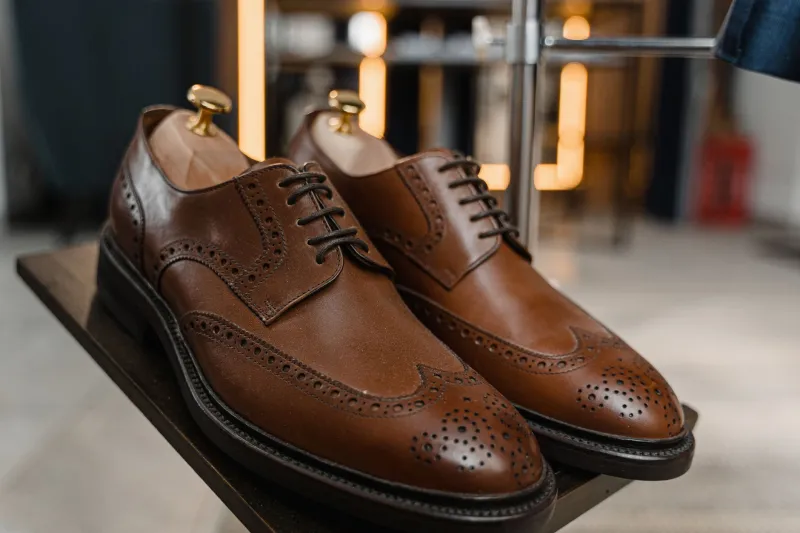
There is a particular kind of optimism that accompanies the purchase of an exceptional pair of shoes. The box is opened, the tissue paper folded back, and for a moment the shoe sits in its perfect, unworn state — a promise of everything it might become. Then comes the first wearing, and with it, reality.
For many, the break-in period is a surprise. Fine shoes, they assumed, would be comfortable from the outset. When they are not — when the heel rubs slightly, when the toe box feels firm, when the arch presses in unfamiliar ways — disappointment follows. Some return the shoes. Others persist without understanding, and cause damage in the process. A few, guided by knowledge or good fortune, navigate those first weeks correctly. These are the people whose shoes, five or ten years hence, fit like a second skin.
The break-in period is not a flaw in fine footwear. It is, rather, evidence of quality.
Why Premium Leather Behaves the Way It Does
Full-grain leather — the material of choice for any shoe worth serious investment — is a natural product with a complex cellular structure. Unlike synthetic alternatives, it has memory, flexibility, and a capacity to respond to the specific contours of the foot that bears it. This responsiveness is precisely what makes it valuable. It is also what makes the early weeks of wearing a process of active adaptation rather than passive acceptance.
When a shoe is new, the leather is firm. The fibres within the hide have not yet been asked to flex repeatedly in the particular pattern that your foot demands. The insole has not been compressed and shaped by your specific weight distribution. The welt and upper have not found the angles of movement that your stride naturally produces. All of this takes time — and it takes the right kind of time.
A shoe made with a Goodyear welt, for instance, has multiple layers of leather, canvas, and cork between the foot and the outer sole. That cork midsole, which will eventually mould to the unique topography of your foot, begins its transformation slowly. The first few wearings compress it fractionally. By the end of the first month, worn correctly, it will have begun to hold a faithful impression of your foot's architecture.
The Mistakes That Compromise This Period
The most common error during break-in is over-wearing. The desire to accelerate the process — to wear a new pair for a full day immediately, to force the leather into submission — produces the opposite of the desired result. Leather stressed before it has warmed and softened will crease unnaturally, develop pressure points, and in some cases crack at stress lines that will never fully recover.
The second error is under-preparation. Wearing new leather shoes without conditioning the upper first, or without wearing the appropriate weight of sock for the shoe's intended use, introduces friction before the leather is ready to accommodate it. The result is rubbing, blistering, and an association of discomfort with a shoe that, properly introduced, would have caused none.
The third, and perhaps subtlest, error is ignoring what the shoe is communicating. Leather in the early stages of break-in is remarkably informative. Tightness across the instep suggests the shoe needs more time on a well-fitted shoe tree between wearings. A specific pressure point at the little toe indicates that localised stretching may be required. Resistance at the heel suggests that a heel grip, applied temporarily, will allow the leather to soften before contact becomes comfortable. These are not signs that the shoe is wrong. They are a language, and learning to read it is part of the education of the considered shoe wearer.
A Practical Protocol for the First Month
The approach that produces the best long-term results is methodical rather than instinctive.
In the first week, wear the shoes for no more than two to three hours at a time, on surfaces that are not excessively hard. Stone and concrete are unforgiving during break-in; carpeted or wooden floors allow the leather to flex without the additional stress of impact absorption.
Between wearings, insert cedar shoe trees immediately. This is not optional. The shoe tree draws moisture from the leather — moisture introduced by the warmth of the foot — and holds the upper in its correct shape as it dries. Without this step, the leather cools and dries in whatever distorted position the wearing left it in, and those distortions accumulate.
By the second and third weeks, wearing periods can be extended gradually. At this stage, the insole will have begun its moulding process and the upper will have softened perceptibly. A light application of leather conditioner — not polish, which is a surface treatment, but conditioner, which penetrates — will support the leather's flexibility without compromising its structure.
By the end of the first month, a correctly broken-in shoe should feel noticeably different from its first wearing. Not merely more familiar, but genuinely more accommodating — as though the shoe has begun to understand the foot it serves.
The Dividend of Patience
The economics of fine footwear are only realised over time. A shoe that costs several times the price of a high-street alternative is not offering value in its first wearing, or its tenth. The value accumulates across years — in the resoling that extends the life of an unchanged upper, in the leather that darkens and deepens with polish and age, in the fit that becomes, gradually and unmistakably, yours alone.
The break-in period is the foundation of that accumulation. Manage it poorly and the shoe may never reach its potential, regardless of the quality invested in its making. Manage it with care and understanding, and those first weeks become the beginning of something that will, in the truest sense, only get better.
Patience, in fine footwear as in so much of British craft, is not merely a virtue. It is a technique.