A Living Accord: How British Craftsmanship Engineers Shoes That Speak to the Foot
There is a persistent and rather unhelpful myth that circulates in certain corners of the fashion world: that a truly fine shoe must, by some unspoken decree, be difficult to wear. That stiffness is a mark of quality. That discomfort is the price of elegance. It is a notion worth examining carefully — and, ultimately, discarding.
The British shoemaking tradition has never subscribed to this view. At its most accomplished, it operates on an altogether different principle: that the relationship between a well-made shoe and the foot it houses is not one of dominance, but of conversation. A negotiation. A living accord, struck anew with every step.
The Architecture Beneath the Surface
To understand why a British heritage shoe feels as it does — and why it often feels better after six months than it did on the day it was purchased — one must look beneath the surface. The upper leather, however beautiful, is only the beginning. Beneath it lies a construction that has been refined over generations, each element chosen not for its appearance but for the particular role it plays in supporting, cushioning, and communicating with the foot.
The insole, typically cut from vegetable-tanned leather in a well-constructed shoe, is perhaps the most eloquent of these components. Over time, it compresses and moulds in precise response to the pressure points of the individual wearer. It is, in the most literal sense, a record of the foot that inhabits it — a topographical map of weight distribution, gait, and habit. No two insoles wear identically, which is why a shoe that has been worn-in properly by its owner becomes, in time, irreplaceable.
The shank — a slender reinforcement running beneath the arch — provides structural integrity without rigidity. It is the spine of the shoe, ensuring that the foot is supported through the natural mechanics of walking without being constrained. In lesser footwear, this component is frequently omitted or substituted with cheaper materials. In a shoe built with genuine care, it is one of the unsung heroes of all-day wearability.
Why Fine Leather Rewards Patience
Leather, at its finest, is a breathing material. It responds to warmth and moisture, to the pressure of the foot, to the particular chemistry of the wearer's skin. A shoe made from high-grade calf leather or supple nappa will, in the early weeks of wear, be engaged in a process of calibration — reading the foot, adjusting its posture, learning where to give and where to hold.
This is why the first few wearings of a genuinely well-made shoe feel different from those that follow. The leather is not yet acquainted with its wearer. It has not yet had the opportunity to soften at the toe box, to ease across the instep, or to settle at the heel. These are not flaws in the construction; they are evidence of the material's intelligence.
A synthetic upper, by contrast, offers no such exchange. It cannot yield in the same graduated way. It neither matures nor adapts. Whatever it offers on the first day, it offers on the last — and frequently rather less, as the material fatigues without the capacity for renewal that leather possesses.
The Human Element: Lasted by Hand
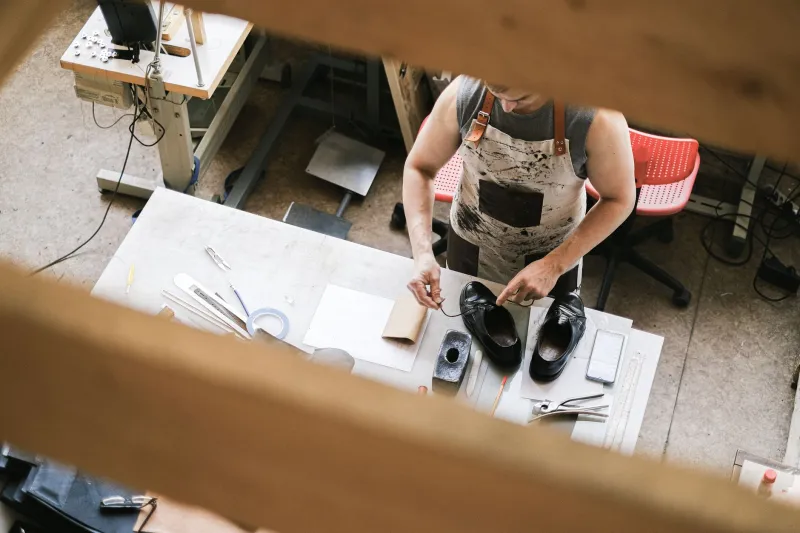
The lasting process — in which the upper leather is stretched and fixed over a wooden form called a last — is one of the most consequential stages in shoemaking, and one in which the human hand remains indispensable. Skilled craftsmen read the leather as they work, sensing where additional tension is required, where the material might be coaxed into a particular shape, where a slight adjustment will determine whether the finished shoe sits beautifully or merely adequately.
British shoemakers have long understood that a last is not simply a generic foot shape, but a designed intention — an expression of how the foot should be held, guided, and supported. The slight elevation of the heel, the curve of the waist, the width across the ball of the foot: each dimension is a considered choice, and each contributes to the experience of wearing the finished shoe. The finest lasts are developed over years, refined by feedback from wearers, and treated with the same respect as any other tool of the trade.
This is comfort engineered from the inside out — not as an afterthought, but as a founding principle.
The Welt: A Junction of Strength and Sensitivity
Among the technical achievements of traditional British shoemaking, the Goodyear welt occupies a singular position. A strip of leather stitched to both the upper and the insole, it creates a construction of remarkable resilience — and, crucially, one that can be resoled without disturbing the integrity of the upper. But beyond its practical virtues, the welt plays a subtler role in the comfort of the shoe.
Because the welt creates a slight separation between the foot and the external sole, it introduces a degree of natural cushioning that is absent in cemented constructions. The foot does not sit directly against the road. There is, instead, a layered system of leather and stitch between body and ground — a buffer that absorbs impact, reduces fatigue, and contributes to that particular quality of walking in a well-welted shoe that is difficult to articulate but immediately recognisable.
Comfort as a Form of Respect
There is something worth saying about what it means, culturally, for a craftsman to prioritise the wearer's comfort. It is, in a sense, an act of respect — an acknowledgement that the shoe exists to serve the foot, not the other way around. The British shoemaking tradition, at its most principled, has always held this view. The formality of a brogue, the sleekness of a court shoe, the robustness of a Derby: none of these aesthetic qualities need come at the cost of wearability. They are, or should be, expressions of the same underlying commitment to excellence.
This is the conversation that a truly fine shoe enters into with its wearer. Not a monologue of rigid form, but a genuine exchange — one in which the shoe listens, adjusts, and, over time, becomes something uniquely suited to the life it has been asked to share.
For the discerning wearer, this is not a small thing. It is, perhaps, the most important thing of all.