Brass, Silver, and Gold: The Quiet Authority of the Buckle in British Shoe Design
There is a peculiar discipline in British taste that resists the obvious. Where other traditions might announce themselves through bold silhouette or vivid colour, the British sartorial sensibility has long preferred to speak in quieter registers — in the weight of a fabric, the finish of a sole, or the precise manner in which a single piece of hardware sits against the vamp of a shoe. It is in this spirit that the buckle deserves serious consideration: not as ornament, but as argument.
For those who understand footwear as a form of considered self-expression, the hardware on a shoe is never incidental. It is, in the most literal sense, the point where craft and intention meet the eye.
A History Worn on the Foot
The buckle's prominence in British dress history is well documented, though rarely examined with the attention it merits. During the late seventeenth and eighteenth centuries, the shoe buckle occupied a position of considerable social significance. Elaborate examples in silver, set with paste stones or polished steel, were worn by men and women of rank as visible indicators of wealth and refinement. The town of Walsall, in the West Midlands, became one of the principal centres of British buckle-making during this period — a heritage that speaks to the deep industrial and artisanal roots of what might otherwise seem a trivial accessory.
When the fashion shifted towards laced shoes in the 1790s, the buckle retreated — but it never disappeared. It found sanctuary in the more enduring forms of British footwear: the court shoe, the loafer, the monk strap. In each, it was refined and reconsidered, stripped of excess until what remained was pure function rendered with elegance.
The Monk Strap and the Measure of Restraint
Perhaps no style better illustrates the buckle's evolution than the monk strap shoe. Originally associated with monastic dress — functional, unadorned, concerned with utility rather than display — the form was adopted by British shoemakers and elevated through the quality of its construction and the precision of its hardware.
The single monk strap presents one buckle, positioned with mathematical deliberateness across the instep. The double monk offers two, and here the maker's judgement becomes critical: the spacing, the proportion of each buckle to the other, the precise angle at which they sit. In lesser shoes, this arrangement can appear busy or confused. In shoes made with genuine craft, the two buckles achieve something close to visual harmony — a rhythm that the eye follows without quite knowing why it finds the experience satisfying.
The buckle on a monk strap is not decorative in the conventional sense. It performs a genuine function: securing the shoe without lace, offering adjustability, framing the foot. That it does so with such quiet confidence is the mark of considered design.
The Court Shoe and the Language of Femininity
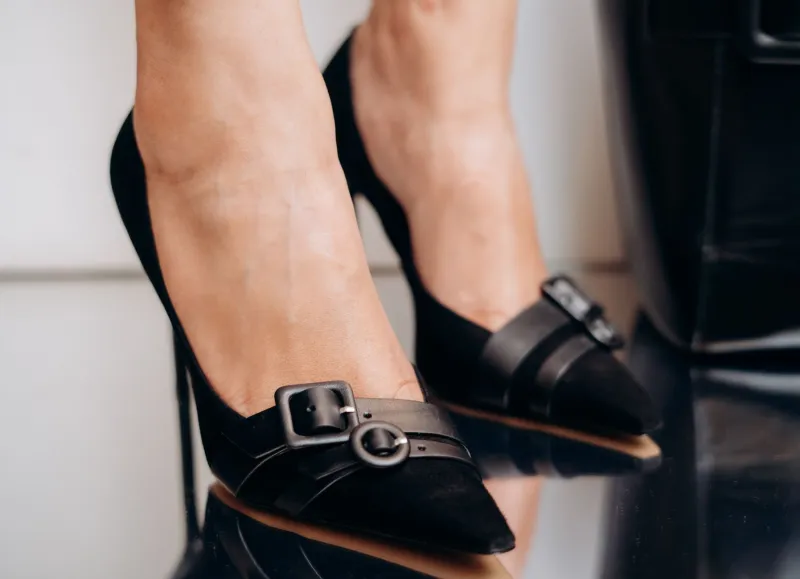
In women's footwear, the buckle has historically carried a rather different weight of meaning. The court shoe, in its classic form, requires no fastening at all — it relies on the fit of the last and the architecture of the heel to stay in place. When a buckle appears on such a shoe, it is therefore purely expressive, and its character speaks volumes.
A small, flat buckle in brushed gold on a pointed-toe court shoe communicates something entirely different from an oversized, sculptural clasp on a block-heeled mule. The former suggests restraint and confidence; the latter, a deliberate theatricality. Neither is incorrect. Both are intentional. The discerning wearer understands that selecting between them is not a matter of preference alone, but of occasion, context, and the precise impression one wishes to create.
British women of taste have long understood this vocabulary. The buckle on a shoe worn to a formal lunch in the City carries different implications from the same buckle worn at a country house weekend. Context is everything, and hardware is one of the most efficient ways of signalling that one understands the difference.
Metal Finish and the Hierarchy of Quality
Beyond form, finish matters enormously. The quality of a buckle is revealed not only in its design but in the manner of its manufacture and the material from which it is wrought. A buckle that has been die-cast from lightweight alloy and electroplated to a high shine will, within a season, begin to betray itself — the plating wearing thin at the edges, the surface acquiring a dull and slightly desperate quality that speaks of economy rather than investment.
Contrast this with a buckle forged from solid brass, finished by hand, and aged deliberately to a warm patina. Such a buckle improves with time. It develops character in the way that all well-made things do: not by deteriorating, but by deepening. The surface acquires a history that is particular to the shoe and its wearer — a quality that cannot be replicated or purchased, only earned through use.
For this reason, the hardware on a shoe is one of the most reliable indicators of a maker's overall commitment to quality. A manufacturer who spares expense on the buckle almost certainly spares it elsewhere. The reverse is equally true: a maker who insists on the finest hardware throughout is demonstrating, in miniature, the philosophy that governs the entire shoe.
The Loafer and the Bit: An American Invention, a British Refinement
It would be incomplete to discuss shoe hardware without acknowledging the horsebit loafer — a style whose signature metallic detail, a small stirrup-shaped bar across the vamp, has become one of the most recognisable motifs in twentieth-century footwear. Though the style's modern incarnation is most closely associated with an Italian house, the British relationship with the loafer runs deep, and the manner in which British shoemakers have interpreted and refined the bit speaks to a characteristic national instinct for understatement.
Where some iterations lean into the drama of the hardware — enlarging the bit, gilding it conspicuously — the British tradition tends toward a more measured approach. The bit is present, it is well made, it does its visual work without demanding excessive attention. This, too, is a form of eloquence.
Reading the Detail, Knowing the Shoe
For those who take footwear seriously — and there are more such individuals in Britain than popular culture might suggest — learning to read hardware is an exercise in developing a more sophisticated eye. It requires slowing down, resisting the temptation to assess a shoe at a glance, and instead giving attention to the elements that reveal the most about how a shoe was conceived and by whom.
The weight of a buckle in the hand. The precision of its tongue. The smoothness with which it fastens and unfastens. The way its finish holds against the leather of the strap. These are not trivial considerations. They are the small, cumulative details through which a shoe earns the right to be called fine.
In this sense, the buckle is not merely hardware. It is a test — and in the best British shoes, one that is passed with quiet distinction.