Posture, Polish, and Presence: What the Condition of Your Shoes Betrays About Your Inner Life
There is a particular kind of self-knowledge that arrives not through introspection but through observation — specifically, through the observation of others. A seasoned professional, entering a room for the first time, will often glance downward before looking up. Not from deference, but from discipline. The shoes, they have learned, rarely lie.
This is not mere superstition. It is a well-established principle, quietly upheld across British professional and social culture, that the condition and presentation of one's footwear functions as an unguarded signal — a projection of inner order, or the absence of it. Understanding what that signal communicates, and learning to read it in oneself, is among the more undervalued forms of self-awareness available to the discerning individual.
The Geometry of Confidence
Consider heel wear. A podiatrist examining a well-used pair of leather Oxfords can identify, within moments, the gait of the person who wore them. Excessive wear on the outer edge of the heel suggests a supinated stride — a walking pattern frequently associated with physical guardedness, the body subtly drawing inward. Uneven wear between the left and right shoe may indicate a habitual lean, sometimes linked to chronic tension or a postural compensation developed under prolonged stress.
None of this is deterministic. Bodies are complex, and wear patterns have numerous causes. But when podiatrists and movement specialists speak candidly, they acknowledge a correlation: the way we hold ourselves when we walk is intimately connected to the way we feel about occupying space. Confident individuals tend to walk with a more balanced, heel-to-toe stride. Their shoes wear evenly, deliberately, as if each step were taken with intention.
British etiquette consultant Caroline Doyle, who has advised corporate clients for over two decades, phrases it plainly: 'When I assess someone's professional presentation, the shoes are always the most honest part of the picture. A beautifully pressed suit paired with neglected footwear tells me that someone has attended to the surface but overlooked the foundation. And foundations, in both architecture and character, are where integrity begins.'
Lace Tension and the Language of Negligence
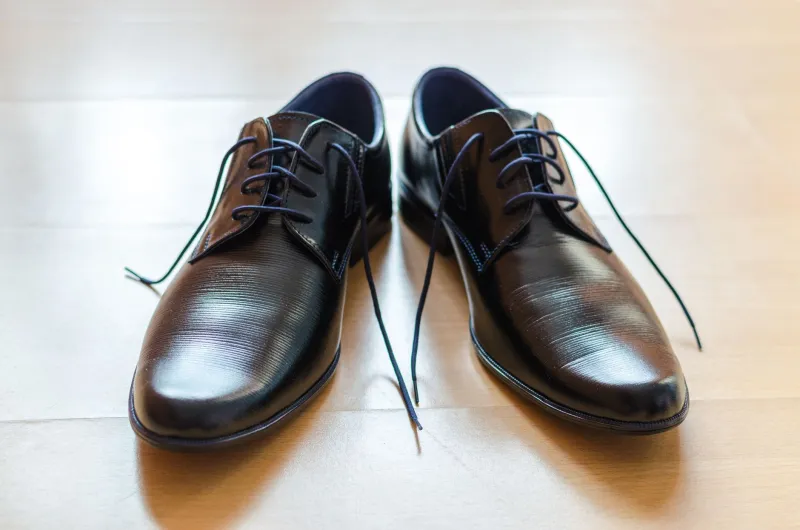
Beyond heel wear, there is the matter of lace tension — a detail so minor it might seem unworthy of examination, yet one that communicates with surprising clarity. A shoe laced tightly and symmetrically, with the bow centred and the lace ends of equal length, suggests an individual who has taken a moment — a quite deliberate moment — to attend to the particular. It is not vanity. It is the visible expression of standards applied consistently, even when no one is watching.
Slack lacing, by contrast, often reflects something more than mere haste. Psychologists who study self-presentation note that individuals experiencing diminished self-esteem frequently reduce the effort they invest in personal detail. The logic is circular but revealing: when we feel less worthy of care, we extend less care to ourselves. And the shoes, worn daily and rarely examined by their owner, become the repository of that neglect.
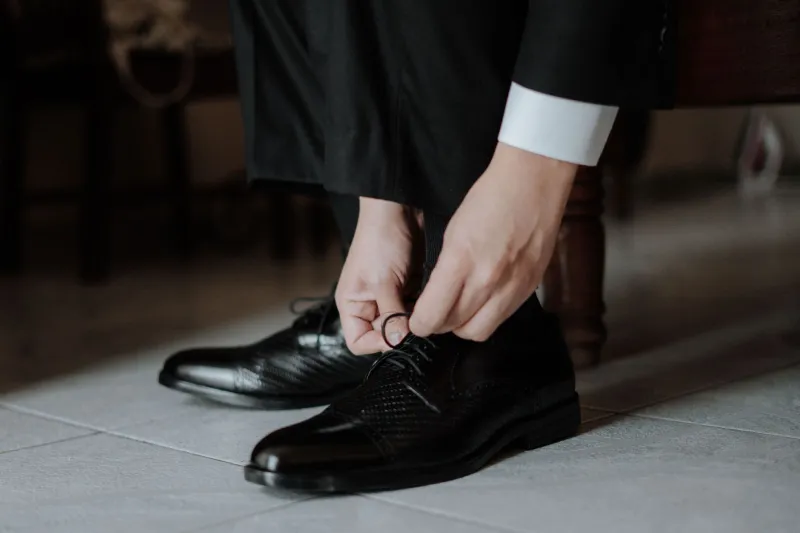
This is not a judgement. It is, rather, an invitation. The act of relacing a shoe with attention — pulling each eyelet taut, ensuring symmetry, finishing with a clean bow — is a small but genuine act of self-regard. It takes perhaps ninety seconds. Its effect on the wearer's bearing, however, is disproportionate.
The Psychology of Polish
There is a reason that military and legal traditions in Britain have long demanded immaculate footwear. It is not merely aesthetic convention. The act of polishing a shoe is meditative in structure — repetitive, tactile, and productive. It demands patience. It rewards attention. And it produces a visible result that is, in the most literal sense, a reflection.
When you polish a leather shoe to a proper shine, you see yourself in it. That is not metaphor. It is physics. And there is something quietly significant about the fact that the object most proximate to the ground — the most humble article of dress — becomes, through care, a mirror.
Psychologists working in the field of self-regulation suggest that maintenance rituals, including the care of objects we own, reinforce a sense of agency and competence. The individual who polishes their shoes regularly is, in a measurable sense, practising self-efficacy. They are asserting, through action rather than declaration, that their possessions — and by extension, their presentation — remain under their stewardship.
Reading the Room by Reading the Floor
For those who have cultivated the habit of observing footwear, British professional environments offer a rich and varied text. In legal chambers, where tradition demands a certain gravity of dress, a barrister's shoes are often scrutinised by senior colleagues as a proxy for professional rigour. In creative industries, deliberate informality in footwear may signal an assertion of independence from corporate convention — a different kind of confidence, but confidence nonetheless.
The key distinction, etiquette specialists consistently note, is between intentional choices and unexamined ones. A pair of scuffed shoes worn deliberately, as part of a considered aesthetic, communicates something entirely different from the same shoes worn through inattention. The former is a statement. The latter is a symptom.
This distinction matters because it returns us to the fundamental question: not what your shoes look like, but what you have decided they should look like. Confidence, in this context, is not the absence of wear. It is the presence of intention.
The Considered Step Forward
At Russell & Bromley, we have long understood that a fine shoe is not merely a purchase but a commitment — to quality, to longevity, and to the daily practice of presenting oneself with care. The leather we select, the lasts we employ, the construction methods we favour: all of these reflect a belief that footwear worthy of the name demands, and repays, genuine attention.
The shoes that leave our collections are designed to age honestly. They will wear. They will mark. They will, over time, carry the imprint of the life lived in them. But the manner of that ageing — whether it speaks of care or carelessness, of intention or indifference — remains, always, in the hands of the wearer.
Your shoes have been observing you since the first morning you put them on. The question worth asking, with some regularity, is what they have found worth recording.