The Smarter Investment: Why the Shoe Rack Outperforms the Handbag in the Long Run
The British professional woman's relationship with her luxury budget is, in most cases, a thoughtful one. She reads the reviews. She considers longevity. She understands, at least in principle, the distinction between price and value. And yet, when she sits down to allocate the portion of her discretionary income reserved for investment-grade fashion, she will almost certainly prioritise the handbag.
This is understandable. The cultural infrastructure supporting handbag investment is formidable — waiting lists that confer status, resale markets that rival equities in their enthusiast following, editorial coverage that frames the purchase as an act of financial intelligence rather than mere consumption. The shoe, by contrast, is treated as supplementary — chosen to complement the bag, selected after the primary decision has been made.
The numbers, examined honestly, tell a rather different story.
The Cost-Per-Wear Calculation
The most useful tool for evaluating any wardrobe investment is the cost-per-wear figure — the purchase price divided by the number of times the item is worn over its functional lifespan. It is a simple calculation, but its implications are frequently underestimated when applied to footwear.
Consider a pair of well-constructed British leather shoes purchased for £450. Worn three times per week across a working year, that represents approximately 150 wearings in the first twelve months alone. Over a conservative lifespan of eight years — entirely realistic for a quality shoe maintained with appropriate care — the total wear count approaches 1,200. The cost-per-wear figure resolves to approximately 38 pence.
Now apply the same calculation to a premium leather handbag at £1,200 — a relatively modest entry point for a recognisable heritage brand. Carried four times per week across the same eight-year period, the total use count reaches roughly 1,664. The cost-per-wear figure comes to approximately 72 pence — nearly double that of the shoes.
The bag, it turns out, is the more expensive proposition — not at the point of purchase, but across the arc of actual use.
Durability: Where the Comparison Sharpens
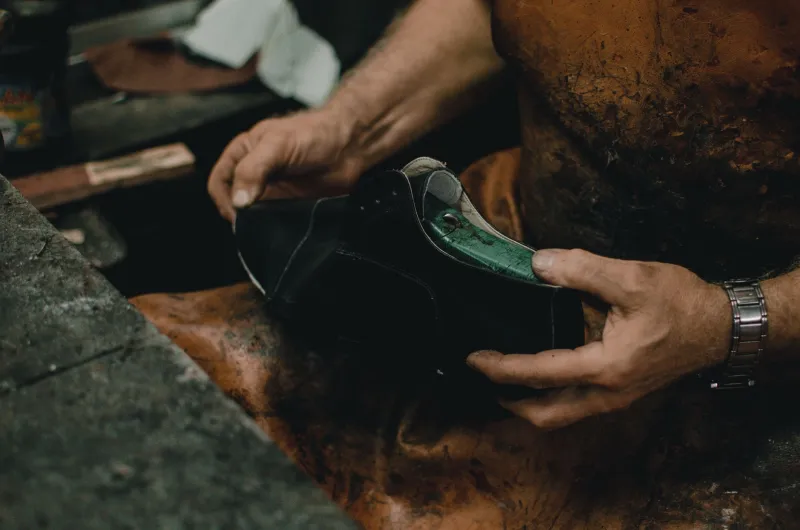
The cost-per-wear calculation becomes still more favourable to footwear when durability is factored in with precision. A well-constructed shoe — built on a quality last, stitched rather than glued, finished in full-grain leather — is not merely long-lasting. It is restorable. The sole can be replaced, the heel rebuilt, the leather reconditioned and refinished. A skilled cobbler can return a shoe of genuine quality to near-original condition multiple times across its life, effectively resetting the cost-per-wear clock.
This is a property that handbags, for all their desirability, rarely share to the same degree. Leather bags can be conditioned and repaired, certainly — but the structural elements that define their silhouette are rarely renewable in the same way. A bag that has lost its shape, or whose hardware has corroded, or whose lining has deteriorated, is typically approaching the end of its useful life. The shoe, by contrast, can be rebuilt from the sole up.
The practical implication is that the total investment required to maintain a quality shoe across a decade may be a fraction of what is required to replace a bag of comparable initial cost. A resoling and recondition at a reputable cobbler might cost £80 to £120. The same sum, applied to a bag, may accomplish nothing more than a surface clean.
The Resale Market: A More Complex Picture
The standard argument for handbag investment rests heavily on resale value — and here, the comparison is admittedly more nuanced. The secondary market for certain heritage handbags has indeed demonstrated remarkable resilience, with specific styles from specific houses appreciating in value over time in ways that have attracted the attention of financial commentators.
However, the handbag resale market is considerably narrower than its enthusiasts sometimes suggest. The appreciation in value is concentrated in a small number of highly specific models from a handful of houses — items that most buyers cannot readily acquire at retail in the first place. For the vast majority of premium handbags purchased at standard retail prices, the resale value at five years is materially lower than the purchase price, and the market is illiquid and unpredictable.
The shoe resale market, while less discussed, is more stable across a broader range of products. Quality British footwear from heritage makers retains its value with reasonable consistency on secondary platforms, and in excellent condition commands prices that represent a meaningful proportion of the original retail figure. More importantly, the decision to retain rather than sell a shoe of genuine quality is rarely a sacrifice — the shoe continues to earn its keep through use in a way that a bag kept primarily as a speculative asset does not.
The Psychological Economy of Footwear
There is also a dimension to this analysis that the purely financial framework tends to underweight: the effect of quality footwear on daily experience. A shoe is in contact with the body for the duration of every wearing. It affects posture, gait, physical comfort, and — through all of these — the quality of attention and ease that a person brings to their day. A bag, however beautiful, is carried at arm's length. Its interaction with the body is more distant, its effect on physical experience more limited.
The professional who invests in genuinely excellent shoes is purchasing not only an aesthetic object but a daily functional advantage. The confidence of a well-made heel, the ease of a perfectly fitted last, the subtle authority that comes from wearing something that has been constructed with genuine skill — these are not trivial returns on investment. They are daily dividends, paid in the currency of how one moves through the world.
Rebalancing the Budget
None of this is to suggest that the handbag is without merit as an investment, or that the pleasures of a beautifully made bag are reducible to a cost-per-wear calculation. They are not. The argument here is more modest: that the consistent prioritisation of bags over shoes in the British professional woman's luxury budget reflects a cultural bias rather than a financial analysis, and that a more considered rebalancing of that budget — one that takes seriously the durability, restorability, daily utility, and genuine cost-per-wear economics of quality footwear — would serve most buyers better in the long term.
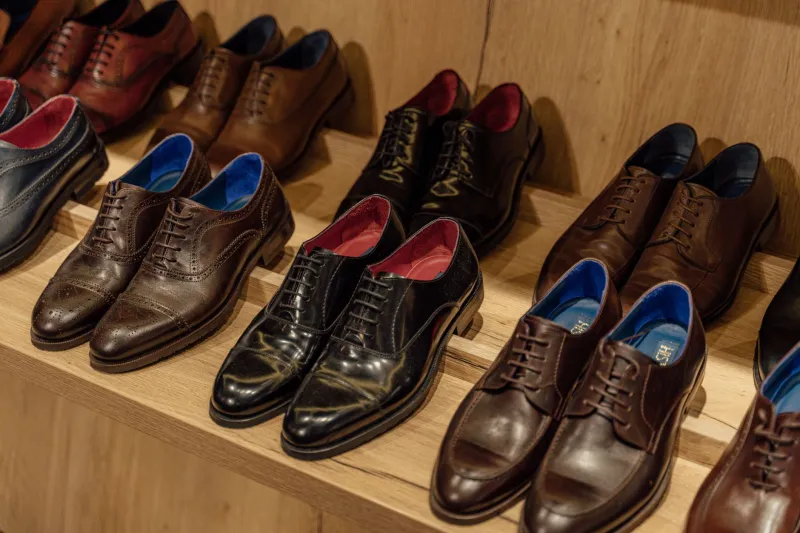
The shoe rack, stocked with fewer but finer pieces, maintained with appropriate care and rotated with intelligence, is a wardrobe infrastructure that compounds quietly over years. It does not attract the same conversation at dinner parties. It will not appear in the same breathless editorial coverage. But when the ledger is examined honestly, at the end of a decade of considered wearing, the numbers make a compelling case that the most discerning investment a woman can make in her wardrobe is the one she makes at the shoe rack — not the handbag shelf.
Perhaps it is time the two were considered on equal terms.