Made Where It Matters: Reading a British Shoe by the Place That Shaped It
Photo: George Willdey, Public domain, via Wikimedia Commons
When a customer selects a bottle of wine, they are often guided as much by region as by grape variety. A Burgundian Pinot Noir and a New Zealand Pinot Noir are made from the same fruit, yet no informed drinker would expect them to taste alike. The soil, the climate, the accumulated wisdom of the local winemaking tradition — all of these shape the final product in ways that cannot be replicated simply by replicating the recipe.
The same logic applies, with remarkable precision, to British footwear. The shoe that emerges from a Northamptonshire workshop carries within it a particular philosophy of construction — formal, structured, architecturally precise — that is distinct from the more yielding, character-led aesthetic of a piece produced in the South West, or the quietly innovative approach of certain Midlands makers working at the intersection of tradition and contemporary design. Geography, in British shoemaking, is not merely a matter of postcode. It is a creative force.
For the customer who wishes to purchase with genuine discernment, understanding these regional distinctions is not an academic exercise. It is a practical tool — one that helps align a purchase with personal style, intended use, and the values one wishes a wardrobe to reflect.
Northampton: The Capital of the Structured Shoe
No survey of British regional shoemaking can begin anywhere other than Northampton. The county's association with the craft extends to at least the fourteenth century, when local tanners and cordwainers supplied footwear to English armies. By the nineteenth century, Northampton had established itself as the unambiguous centre of the British shoe trade, its terraced factories producing footwear of international renown.
What Northampton developed, across several centuries of concentrated expertise, was a philosophy of construction rooted in precision and permanence. The Northampton house style — if one can generalise across the many distinguished makers who have operated from the county — tends towards the formal and the structured. Lasts are cut to exacting tolerances. Welting is executed with mechanical discipline. The silhouette is clean, confident, and unambiguous in its intentions.
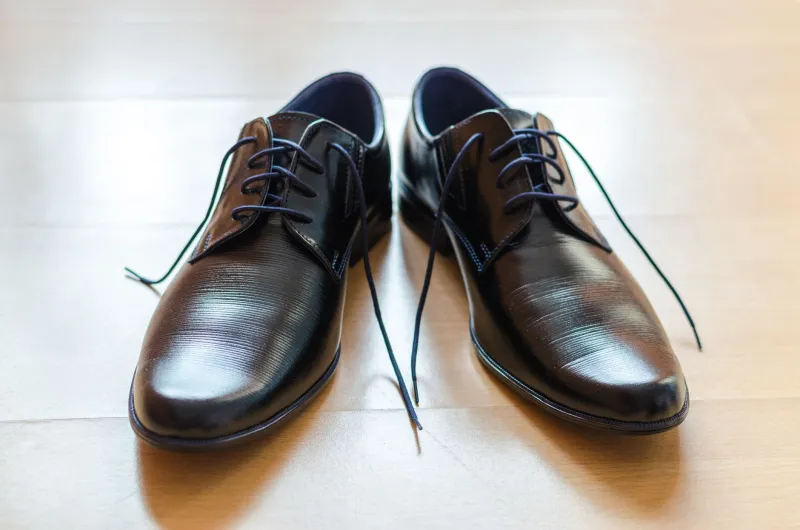
This is footwear conceived for the professional register: the Oxford brogue worn to a boardroom, the Derby that accompanies a morning suit, the loafer that navigates effortlessly between a country estate and a London club. Northampton shoes do not ask for interpretation. They make a statement, and they make it with authority.
For the customer whose wardrobe centres on formal or semi-formal occasions — or who simply values the clarity of a well-defined silhouette — a shoe with Northampton provenance represents the most direct route to that particular kind of confidence.
The Midlands Workshops: Where Tradition Meets Considered Innovation
Beyond Northampton's established houses, the broader Midlands region harbours a network of smaller workshops whose output is less immediately categorisable but no less worthy of attention. These makers — often operating with smaller teams and shorter production runs — have the latitude to experiment in ways that volume manufacturers cannot afford.
The aesthetic tendency in these workshops leans towards a thoughtful hybridisation: traditional construction methods applied to silhouettes that engage with contemporary taste without capitulating to it. You might encounter a hand-welted Derby in an unexpected colour of pit-tanned leather, or a Chelsea boot whose proportions have been reconsidered with the modern wardrobe in mind. The construction is rigorous; the interpretation is more fluid.
For customers who regard themselves as genuinely engaged with style — who wish their footwear to reflect a considered personal aesthetic rather than simply fulfil a social function — the Midlands workshop tradition offers a productive middle ground. These are shoes for the individual who knows the rules thoroughly enough to bend them with purpose.
The South West: Leather with a Life Already Lived
The South West of England contributes to British shoemaking in a manner that is perhaps less immediately visible but no less significant. The region is home to some of the last surviving traditional tanneries in the country — most notably in Devon, where oak-bark pit-tanning continues to produce leather of exceptional quality for a devoted community of makers.
Shoemakers who source from these tanneries, whether based in the South West themselves or operating further afield, tend to share certain aesthetic priorities. The leather they work with has a density and depth of colour that announces itself quietly but unmistakably. It develops a patina with wear that chrome-tanned alternatives cannot produce. The shoes it yields have a lived-in quality from the outset — not scruffy, but settled, as though they have already found their purpose.
The style associated with this tradition is correspondingly relaxed in its formality, though never careless. Country shoes, walking boots, and robust weekend footwear find their finest expression here: pieces that are as comfortable on a Dartmoor bridle path as they are in a rural pub. For the customer whose life moves between town and country — or who simply prefers footwear that wears its quality without announcement — this tradition speaks directly.
Reading Provenance at the Point of Purchase
Understanding regional tradition is useful only if one can apply that understanding when selecting a shoe. The following considerations help translate provenance into practical guidance.
Construction method as regional signature. A Goodyear-welted shoe with a close-trimmed, lacquered edge is almost certainly working within the Northampton tradition, whether or not it was made there. The method has become the regional signature, adopted by makers who aspire to that particular standard. Conversely, a shoe with a more rustic edge finish, a hand-stitched welt, or a deliberately uneven burnish is likely drawing on a smaller-workshop tradition.
Leather character as geographic indicator. Leather that appears almost waxy in its density, that shows depth of colour without high gloss, is likely sourced from a traditional tannery. This is leather with a slower provenance — and a longer future. Leather that is very uniform in texture and colour, whilst not necessarily inferior, suggests a more industrialised supply chain.
Last shape as cultural expression. The last — the foot-shaped form over which a shoe is constructed — encodes the aesthetic priorities of its maker. A long, tapered toe with a relatively shallow throat speaks to formal British tradition; a rounder, fuller last suggests a maker more interested in comfort and character than in silhouette. Neither is superior; both are deliberate.
Scale of production as quality signal. This is not an absolute rule, but smaller production runs generally permit greater individual attention. A maker producing two hundred pairs a year is working in a fundamentally different register from one producing two hundred thousand. The former can afford to notice things.
The Value of Knowing Where You Stand
Britain's regional shoemaking traditions are not museum pieces. They are living practices, shaped by geography and community, continuing to evolve whilst remaining rooted in distinctive local philosophies. To engage with them as a customer is to participate in something larger than a transaction — it is to connect with a lineage of craft that has shaped not only how Britain dresses its feet, but how it understands quality itself.
The most informed purchase is always one made with knowledge of what you are buying and why it was made the way it was. In British footwear, that knowledge begins with place.